
Updated in 2025
There are so many excellent choices for non-toxic, healthy, green insulation, there should be one to fit everyone’s needs.
Look Out For Greenwashing
There are many new options that claim to be “green” “soy-based” or are formaldehyde-free – this does not mean that they are VOC-free or safe.
Look very closely at what’s in it.
Also, flame retardants and mildewcides are not counted as VOCs.
Green Certified?
Certifications are not that useful here: almost every insulation now qualifies as GreenGuard Gold, which for sensitive folks is not enough information.
This article contains affiliate links, upon purchase I earn a commission at no extra cost to you.
Summary:
What is the Safest Insulation Well, that depends. Technically, the options with no off-gassing and no additives are the purest. But the natural odors in the organic options might not agree with everyone. Neither will the cost or availability. Mineral wool is my top pick for most people, in most cases, because it’s simple in its composition and comes to a complete cure. The types are outlined below organized by where they are used in the home, and in the order in which I would consider them. My opinion on which ones are best for the chemically sensitive, can be found in my book and course.
Batt Insulation for Walls
1. Fiberglass Insulation

Fiberglass is the most common insulation used in standard stick-framed houses in Canada and the US. For this reason, I am starting here.
It’s not actually my top pick in the batt category because it’s not a compression fit into the walls, and therefore may not guard against air currents as well as mineral wool and some other options.
You can use it between wood studs of a house, between floor joists, and in the attic.
It is used in many trailers, but I don’t recommend that.
This option has improved dramatically in recent years, and the many of the batt brands are now extremely low in VOCs.
Formaldehyde-Free Fiberglass Brands:
1. Knauf EcoBatt – They are formaldehyde-free and they use a starch-based binder listed on their Declare label. Other ingredients include ammonium sulfate (fire retardant), mineral oil (dedusting), and silane.
More brands in the book or course.
Are there Flame Retardants in Fiberglass?
Knauf lists ammonium sulfate which is used as a flame retardant, Owens Corning lists no flame retardant, Certainteed doesn’t list a flame retardant but they do have an undisclosed additive.
Blown-In Fiberglass
Blown-in fiberglass that I have looked at recently contains borates, soda ash, lime, siloxanes/silicates/silane, mineral oil, and an unknown anti-static additive.
Fiberglass Insulation Around Pipes
The fiberglass insulation for around pipes that I have seen is also formaldehyde-free.
- R-Value
- 3.5 inches is R-11-R-15.
- Cost USD (2020)
- Knaff Ecobatt is 0.49/sq ft and you can buy it at Home Depot or through your contractor.
2. Mineral Wool Insulation

Mineral wool is in widespread use by builders who build green or high-quality homes and it is the most obvious alternative to fiberglass.
It is also easy to source.
Pros:
- The batts can be used between wood studs anywhere in the house.
- It’s very good at staying in place with compression fitting, so it fits well between framing.
- It fits and holds up well in ceiling joists.
- Blown in mineral wool can be used in the attic floors.
- It can be used on basement walls.
Non-Toxic Mineral Wool Brands
1. Rockwool is the most common and accessible mineral wool insulation.
They have a newer version, called AFB evo, that does not contain formaldehyde. The binder appears to be starch-based. It also contains mineral oil.
It’s much harder to source than their standard batts.
Rockwool ComfortBatt is the type for perimeter exterior walls, Safe N Sound, their soundproofing version is for interior walls, and ComfortBoard is exterior insulation (outside of the sheathing).
All three contain the same binders/additives: <3% phenol-formaldehyde, <1% starch, and <0.2% mineral oil source.
I look closer at the metals found in Rockwool in my book and course.
They have a blown-in option, though it’s not available in North America in late 2024.
2. Thermafiber by Owens Corning is a brand that has a regular phenol-formaldehyde line and a formaldehyde-free line (you will see the letters FF), the latter usually has to be special-ordered through a store.
A blown-in option is mentioned in the book and course.
Other Info
An easy way to cut through mineral wool is with an electric carving knife.
This insulation has good soundproofing qualities. The Safe N Sound version can be used on interior walls for soundproofing between rooms.
The fibers are not safe to breathe in and can cause a contact allergy if you are not using gloves.
- R-Value
- 3.5 inches is R-15.
- Cost USD (2020)
- $0.95/ sq ft for Rockwool (Comfortbatt, 3.5 inch)
- Where to Buy
- Rockwool and Thermafiber at hardware stores across the US and Canada, or through your contractor.
3. Wool Batt (and Blow-In) Insulation

Wool batting can be used between wood-framed walls and in the attic floor.
It’s more expensive than fiberglass and mineral wool above.
Top Brands of Wool Insulation
1. Havelock Wool has no synthetic fibers and no binders. It’s only wool and boric acid. They provide a Declare Label for all of their ingredients. This is the purest of the wool options (and one of the most natural insulation types all around).
You can buy it online which makes it the most accessible wool brand.
Borates are low-toxicity compounds, explains Dr. Mudgal, Toxicologist, but can cause irritation or harm if inhaled or ingested in large amounts. The risk is negligible once the material is installed and enclosed, as exposure pathways are blocked, she says.
More brands in the book and course.
Blown-in Wool Insulation
While none of them claim organic certification, wool is one of the purest options.
Borates are low-toxicity compounds, explains Dr. Mudgal, Toxicologist, but can cause irritation or harm if inhaled or ingested in large amounts.
The risk is negligible once the material is installed and enclosed, as exposure pathways are blocked, she says.
- R-Value
- Wool in batts has R-13.7 in 3.5 inches
Blow in dense-pack R-value: can be 15.3 in 3.5 inches
- Wool in batts has R-13.7 in 3.5 inches
- Cost USD (2020)
- Havelock Loose Fill is $1.97/sq ft
Havelock Batts is $1.62/sq ft
- Havelock Loose Fill is $1.97/sq ft
- Where to Buy
- Buy through local green building supply shops or buy Havelock online.
4. Recycled Cotton Batt

Ultratouch Insulation is what my builder used in my chemical-free tiny home (I later removed it).
It used to be made from new denim scraps, but they have moved to recycled denim now.
It does contain boric and ammonium sulfate and an olefin-binding fiber (polypropylene or polyethylene).
My opinion on this insulation can be found in the book on healthy building materials.
- Other Info
- Wear an N95 mask while cutting and installing as it does get extremely dusty when working with it.
- R-Value
- For the 3.5” thickness, you get an R-value of 13
- Cost USD (2020)
- $0.79/sq ft
- Where to Buy
- Check online stores, it’s no longer listed on Home Depot or Lowes websites.
5. Hemp Insulation

Hemp insulation is the newest alternative insulation in the North American market.
It’s been used for much longer in Europe.
I think it is very promising.
It’s harder to source and more expensive than some of the other options in this category, but it could be really great for someone who wants something mostly natural and who hasn’t done well with the other options above.
Brands
HempWool is 90% hemp and 10% polyester. Order from Hempitecture.
More brands in the book and course.
Companies have been coming and going out of business rapidly in the hemp insulation industry.
Sodium carbonate (soda ash) can be used as a flame retardant.
Ask them what they add to it, apart from hemp: alternate fibers, binders, flame retardants, and if it’s organic. And always test a sample first! Note that Polyester is not biodegradable.
- R-Value
- It is R-13 for 3.5 inches
- It is R-13 for 3.5 inches
- Where to Buy
- Contact the companies on where to source it.
Blown-In Insulation
1. Cellulose

Recycled cellulose is a blown-in insulation made from mostly recycled paper that contains a fire-repellent like boric acid.
Newspapers are made with “soy-based” inks but they still contain many other chemicals in the inks apart from soy, plus many other paper sources are used now.
There are also additional additives in the insulation.
Dense-packed cellulose is often used in Passive House design, which has great attention to details around moisture management and green healthy materials.
It is used in both walls and attics.
Safe Brands of Cellulose Insulation
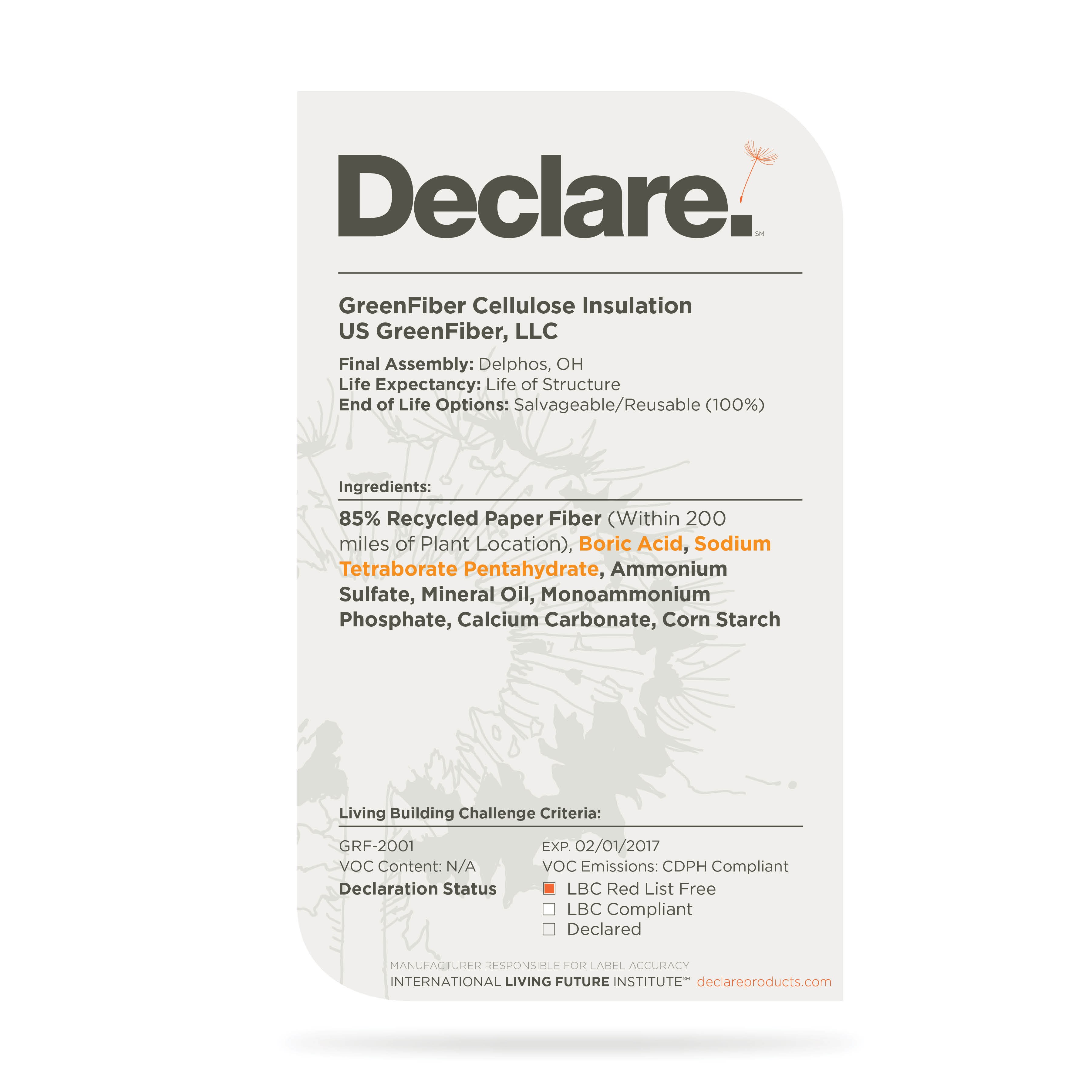
1. GreenFiber brand from Lowes and Home Depot is 85% recycled paper. They have a Declare Label which lists boric acid, sodium pentaborate pentahydrate, ammonium sulfate, mineral oil, monoammonium phosphate, calcium carbonate, and corn starch.
A closer look at the brands and what’s in them can be found in the book and course.
- R-Value
- 13.3 for 3.5 inches
- Cost USD (2020)
- $0.32/sq ft
2. AirKrete Cementitious Insulation
AirKrete is a cementitious blown-in insulation that claims to be VOC-free.
It has passed the “sleep next to it test” of many chemically sensitive people.
The company, however, has declined to participate in the industry-standard VOC test as well as the proper R-value test last I checked, so there is some doubt around this product’s claims.
We don’t know what the undisclosed 2% of this product’s ingredients are, but many with severe chemical sensitivities have chosen to go with this option and have done well with it.
Some people have reported shrinking, crumbling, and trouble drying. Here is the source for the concerns.
Paula Baker-Laporte continues to recommend this insulation, so I’m assuming that many are still doing well with it.
It can be used in walls and roofs. (Consult with an architect when designing an unvented roof).
Non-organic options like AirKrete are more likely to be hypoallergenic.
I would not use this insulation myself.
- R-Value
- R-13 for 3.5 inches
- Cost USD
- Around $2.25/sq ft including installation costs
- Where to Source
- You would have to check to see if you have a certified installer in your area before proceeding.
3. Real Wool, Mineral Wool, and Fiberglass Blown-In

These three insulation types can be blown in as well. Fiberglass (pictured) is the most common blown-in insulation, followed by cellulose.
Mineral wool and real wool blown-in are less common but are healthier choices.
Brand names can be found in those respective sections above.

Exterior Insulation for Houses
1. Styrofoam/Rigid Foam
i. Polyisocyanurate “Polyiso” Foam Board Insulation

Polyiso is one of the insulation types that is used on the exterior side of sheathing.
Typical current blowing agents for polyiso are CO2 and pentane.
There is some “thermal drift”, meaning the blowing agents off-gas over time. The off-gassing is extremely minimal.
It can be used in trailers and metal structures as well. It’s not to be used under slabs.
Flame retardants are a bigger concern than trace pentane. The most common flame retardant is TCPP.
Dr Mudgal, Toxicologist explains “TCPP has documented high toxicity for reproductive and developmental health. It is now classified under REACH regulations as a Category 2 carcinogen (it is suspected of causing cancer based on animal studies or other evidence). It is also persistent in the environment. The aquatic toxicity is moderate, but it varies by concentration and exposure time.”
It’s best to look for brands that don’t use a halogenated flame retardant like TCPP. Newer and safer flame retardants are non-halogenated phosphorus-based.
Though the foil does block the FR, the edges are unsealed and it will never be perfect.
Brands of Polyiso Foam Insulation
1. Johns Manville Foil Faced Polyiso has been the most popular brand among those who are sensitive, but they have discontinued Energy 3E, which was the one made without TCPP (all they have said is that it is phosphorus-based and is non-halogenated).
3. ZIP System R-Sheathing is the Huber Zip OSB sheathing, polyiso, and weather-resistant barrier all in one. Though you can use the above two brands as exterior insulation on the outside of the plywood or OSB, “ZIP-R”, as this type is normally called, is integrated with the sheathing, with the polyiso on the interior side. The flame retardant is TCPP.
My top brand is in my book and course.
2. GAF polyiso EnergyGuard-NH uses a halogen-free flame retardant (which is phosphorus-based, like the Energy 3E FR was). “Unlike TCPP, the flame retardant becomes part of the polymer backbone of the insulation—so there is no free flame retardant that can leach out”, according to GAF’s director of sustainability Martin Grohman. “TCPP, by contrast, is not chemically bonded to the polyiso polymer, so it can more readily escape.” Source
- R-Value
- Technically it’s R-6/ inch but it’s really about R-5.6/inch over its lifespan because it loses R-Value over time. It also loses R-value the colder it gets.
- Cost by R-Value (R6)
- R-6 is $0.60 / sq ft
ii. Extruded Polystyrene (XPS)

XPS (extruded polystyrene) is another common exterior insulation outbound of the sheathing.
It is also used on exterior concrete basement walls, underneath the slab, and in trailers.
XPS, like polyiso, has some “thermal drift” i.e. some very slow off-gassing of the blowing agents over time. “Over a long period of time (50 to 75 years), the blowing agent slowly diffuses through the thickness of the foam” (source).
Typical blowing agents for XPS are CFC-12, HCFC-142b, and HFC-134a, but they change their formulas over time.
HFCs contribute to global warming.
Changes started January 1st, 2021. Eleven states have banned foams blown with HFC-134a and other high-GWP blowing agents, including HFC-245fa as of January 1st, 2022.
A ban on high-GWP blowing agents also went into effect in Canada on Jan. 1, 2021. Canada did not ban HFC-134a but created maximum GWP for foam blowing agents.
Ownings Corning doesn’t use HFC-134a (GWP of 1430) anymore, they now uses a hydrofluoroolefin (HFO) blowing agent with a GWP of less than 80. And DuPont now offers a reduced GWP foam available in Canada and HFC-regulated U.S. states. The blowing agent is not disclosed. They say that the GWP was reduced by 20%+ (source, source, source).
XPS insulation was treated with the flame retardant hexabromocyclododecane (HBCD) until recently.
The two main brands no longer contain HBCD.
They are now using a butadiene styrene brominated copolymer as the flame retardant (source), this flame retardants is less bioavailable and has a lower toxicity profile, though its long-term effects are still being studied, says Dr. Mudgal, toxicologist.
- R-Value
- R-5/inch
- Cost by R-Value
- R-5 is 0.60/ sq ft
2. Mineral Wool Board

The other common and easy-to-source exterior insulation used in the US and Canada is Rockwool, in board form.
Rockwool Comfortboard is being used more and more as many codes across the US have shifted to requiring exterior insulation.
There are no flame retardants in Comfortboard and while it does contain formaldehyde this will be fairly quick to off-gas.
Foam and Rockwool will be the two main exterior insulation types to consider since they will be familiar to builders and easy to source.
The boards can also be used on interior basement walls. They are also used under the slab.
- R-Value
- R-4/inch
- Cost by R-Value (R6)
- R-6 is $1. 24 sq ft
3. Cork

Thermacork insulation, unlike cork flooring, does not contain adhesives. It is held together by compressing it with heat which releases a natural binder in the cork.
The cork does give off a smoky smell that dissipates with time, as well as the natural odor of cork.
This is a newer product in North America and is more expensive than the more conventional options.
It can be used as exterior insulation or even the facade of a house which serves the purpose of siding, insulation, and noise reduction.
See this post as an example of cork used as the facade.
- R-Value
- R-4/inch
- Cost by R-Value (R8)
- R-8 (doesn’t come in R-6) it’s $4.93/sq ft for the insulation type (rougher than the facade)
R-8 in the facade grade, which covers your exterior insulation and your siding in one, is 10.77/sq ft
- R-8 (doesn’t come in R-6) it’s $4.93/sq ft for the insulation type (rougher than the facade)
- Where to Buy
- You can buy this through green building supply stores.
4. Wood Fiberboard Insulation

Wood fiberboard is often used in High Performance/Passive House designs as exterior insulation. It can be used closer to the interior as well.
One popular brand in North America is Gutex. It is 95% wood (spruce/fir, post-industrial, recycled, and new wood), 4% polyurethane, and about 1% paraffin. The total VOC level is 187 μg/m3.
- R-Value
- R-3.7/inch
- Cost
- R 5.8 is $1.81/sq ft
- Where to Source
- You can buy this through 475.
Under the Slab Insulation
The most typical insulation for under the slab is XPS foam board. EPS foam board is sometimes used, both are mentioned above.
You can also use Rockwool Comfortboard under the slab, though it’s more common in Europe.
Glass Foam Blocks
One other unique insulation type for under the slab is foamed glass that comes in panels or chunks.
It is made by heating a mixture of crushed or granulated glass and a blowing agent (chemical foaming agent) such as carbon or limestone.
There is no need for flame retardants or other hazardous chemicals.
This has been used in Europe much longer than in the US.
This is what I would personally use under a slab.
I write/talk more about this in the book and course.
Insulation Typically Used in Trailers, RVs, and Vans
1. Rigid Foam
EPS (Expanded Polystyrene aka Styrofoam)

EPS (expanded polystyrene) is often used in trailers and can be referred to as “block foam” by the companies.
It can also be used as exterior insulation, insulation over concrete basement walls on the interior, and under the slab. Though you are far more likely to see the XPS type of styrofoam under a slab.
Blowing Agents
EPS usually is made with pentane as a blowing agent, the final product has trace amounts of pentane which dissipates rather quickly and completely. Some butane can also be used as a blowing agent.
Sometimes the only blowing agent is carbon dioxide (based on DOW xnergy Declare label).
Zero-VOC
EPS, despite the name (polystyrene), does not off-gas styrene under normal conditions.
I have seen it listed as 0-VOC or very low VOC (with one SDS sheet listing 1.8% pentane, though that dissipates quickly).
What about Styrene?
The concerns over polystyrene (styrofoam) and styrene come from the following a) chemicals released during the manufacturing of the product b) the product is very toxic if you burn it and c) the styrene can leach if you drink beverages especially hot or acidic beverages out of styrofoam cups.
This is a very old product with a long track record. Here are a couple of links to back up the claims.
In the form of insulation, I would consider this product to be non-toxic, zero-VOC, odorless, and stable, with the only risk being the flame retardants.
Flame Retardants
EPS used to be treated with hexabromocyclododecane (HBCD), but luckily it no longer is. Polymeric FR (a copolymer of polystyrene and brominated polybutadiene) is now the most common FR.
The foil faces on these insulations block the flame retardants. However, the foil and plastic-backed versions can have some off-gassing odor. Some EPS is not backed with anything.
If using EPS in a living space I would recommend borate-treated foam to prevent ants from tunneling in.
R-14 for 3.4 inches EPS.
2. Reflectix and Prodex Insulation
Reflectix is a bubble foil made of aluminum over polyethylene bubble wrap.
It is flexible, very thin, and claims to have a very high R-value. The thicker version claims R-21 (which is higher than 5 inches of wool).
These claims are disputed by Green Building Advisor and the Government of Canada. The former states that the 3/8th-inch foil has an R-value of only 1 (the same as a single pane of glass).
This would hardly be useful anywhere unless it is in a curved trailer, RV, or vehicle where all other options have been ruled out. Sometimes it’s just used to insulate windows, which can be a great help.
Prodex is another similar material – foil and polyethylene-based – that also has a disputed R-value.
3. Aerogel Insulation
Aerogel is a fairly new product – unusual, extremely expensive, and harder to source.
The term itself can refer to a variety of materials from the original silica translucent product to polymer-based products that may include the addition of fibers.
The original Aerogel insulation was developed by NASA.
Aspen Aerogel collaborated with NASA to make their polymer-enhanced aerogel combined with fibers.
Some companies are selling insulation online that they claim is Aerogel. I would look closely at what’s really in it. Look for proper studies on the R-value of it.
They claim an extremely high R-value of R-10 to R-30 per inch.
This may be ideal for small, round, and difficult to insulate places, if you can source it.
4. Thinsulate Insulation
3M Thinsulate is an insulation used in vans, other vehicles, and RVs.
It is made of polyethylene terephthalate (a type of polyester) and polypropylene fibers which will be tolerable for most people. The backing is polypropylene.
One percent or less of the additives are proprietary and therefore unlisted. The health rating is 0 which is good.
What I don’t love about using this product in vehicles is that the insulation itself is vapor permeable and it is attached to the walls with 3M 90 Spray (GreenGuard certified, not GreenGuard Gold, not reported to be very tolerable by many chemically sensitive people).
R-value
5.2 for the 1.65-inch
NB. I have seen similar but more unusual insulation made from polyethylene and polyester for homes in batts. (It is more popular in some countries outside of North America.) It may be tolerable for sensitive folks depending on what is added to it.
5. Vacuum Insulation Panels
Vacuum Insulation Panels have the highest insulation value of any of the insulation materials.
These Panasonic panels have an R-value of R-60 per inch. They were used in the latest Leaf House design (tiny house). This could allow you to build a tiny house for almost any climate. Though this introduces a tricky metallic vapor barrier which needs to be carefully thought out.
The foil vacuum pack will block any VOCs from migrating through, but your moisture management system would have to be planned carefully here.
These won’t work in most houses. You might consider them in some trailers or metal-framed homes.
They are very pricey and harder to source than almost all of the other options.
6. Non-Toxic Spray Foam Insulation?

Spray foam that is used to fill cavities of walls is two-part polyurethane. Some of it may have soy added, but it’s still mostly polyurethane foam.
This insulation has to be mixed perfectly, under the right conditions (there are many), and applied correctly.
When looking for a good spray foam you are looking for an excellent installer (the best one you can find) and not a specific brand.
The companies have claimed that it is no VOC, or close to that once cured, but many individual tests and many individual noses of those sensitive have shown otherwise.
I know moderately sensitive folks who have looked at many houses with spray foam and been able to pick up the odor for two years.
And that’s when it’s done right. When it’s done wrong, it’s a massive disaster that can end in a lawsuit against the company, plus an expensive imperfect removal of all the foam.
If you are extremely sensitive, you would lose the whole house if this goes wrong, as the VOCs will soak up into other materials. This has happened to two of my clients.
Brands:
Icynene and Demilic are both 2-part polyurethane spray foam.
Whether they have soy or castor oils in them is insignificant in my overall view.
Icynene OC No Mix is still a 2-part polyurethane foam and although it appears to mix in the gun, the installation still has to meet all of the other parameters.
One-part polyurethane:
One-part polyurethane, the canned stuff, is much easier to tolerate; it’s used in small quantities, and it doesn’t have the same challenges and risks as the 2-part foam.
Insulating Around Windows and Doors – Non-Toxic Options
Non-toxic insulation for the rough opening around windows that is mold preventative is in the book and course.

Corinne Segura is an InterNACHI-certified Healthy Homes Inspector with certifications in Building Biology, Healthier Materials and Sustainable Buildings, and more. She has 10 years of experience helping others create healthy homes. You can book a consult here.

Phacha
Thank you this is very helpful thank you. I’m developing a healthier local alternative for indoor insulation. There’s a lot of research out there on using kapok as layering, but given kapok sheet high flammability even if it’s compressed with bio based polymer, are there possibility of putting it together with cork and other materials that have been treated with flame retardants like Burnblock?
Libby
This is amazing information, thank you for making this easy to follow and understand.
I am building a barndominium and trying to figure out the best type of insulation. Most insulation is closed cell spray foam. Are there any other options to insulated a 60x40ft metal building besides spray foam? Thank you
Corinne Segura, Building Biologist
It depends on if you are heating it, in most heating climates a bardominium with no rainscreen is not a proper wall assembly. people try to make the best of that improper wall structure by using spray foam. but if there is no rainscreen and it is a heating climate then there may not be a good solution there. talk to cheryl cieko.
Curtis
Corinne, thank you so much! Such a wealth! We have a very small job – one 8’x4′ square in the ceiling and a 12″ x 9″ cut out in the exterior wall where insulation was removed and water damage was remediated post roof leak. We have fiberglass insulation in the room already, sans these 2 areas that need new insulation. We have chemically sensitive, asthma, in the house and a small child’s bedroom is extremely close to the room getting repaired. I read your article – would you recommend Owen’s FF Fiberglass over the Rockwool since we will be home during the project and it will be offgassing for 2 weeks? We plan to keep containment up but we still need to get in there to prime and paint. Any issues given it’s proximity to our bedrooms in terms of offgassing? AFB EVO is not as easy to get and will extend the project date out a few weeks. Is it worth the wait? Or do you receommend Owens for this job? Thanks!
Corinne Segura, Building Biologist
i think the FF fiberglass would be good, but it depends if there is someone with chemical sensitivities or not. chemical sensitivities dont track exactly with off-gassing or toxicity
Curtis
Thanks! Can you please elaborate? Not sure I’m following. What do they track with then?
Johannes Hatfield
Dear Corinne,
Thank you for your very interesting post on insulation. I am currently planning to build a house that is as close to zero-chemical as possible. Due to unfortunate past housing and mold exposure, I have developed extreme sensitivity to chemicals and mold.
I thus want to sare some of my thoughts on building with you and others on this web-page. My planned construction:
-Structure: Steel piles / steel foundation with timber frame construction. Since I react to certain wood species (spruce, pine, others), I aim to encapsulate most structural wood within the assembly.
-Wall build-up: Timber cladding, fiber-gypsum wind boards, Austrian sheep wool insulation (Isolena), Pro Clima Intello Plus vapor control layer to block emissions from spruce framing, plus a service cavity insulated with sheep wool.
Interior walls: 12 mm MgSO₄ boards finished with KEIM silicate plaster and silicate paint.
-Subfloor: 25 mm MgSO₄ boards with large porcelain tiles installed using Kerakoll Bioflex adhesive and matching grout.
-Roof: Compact roof with XPS insulation on the cold side layed on MgSo4 30 mm, protected by 0.4 mm PE foil (radon barrier) to the interior. Interior ceiling in MgSO₄.
-Windows: Fully aluminum frames, insulated with sheep wool (Isolena window filler).
-Kitchen: Considering MgO/MgSO₄-based panels, possibly steel or aluminum solutions.
-Alternative floor option: Cement-based terrazzo-style floor (though concerned about binders). Currently, I am living in a house where I react daily with neurological symptoms and asthma (my FEV1 has dropped 13% over five months), so look forward for some relief!!
A few questions:
– In your experience, does shellac effectively block off-gassing from exposed structural wood (e.g., beams or rafters)?
– What is your experience with MgSO₄/MgO boards, considering they contain small percentages of binders?
– Any concerns regarding cement-based terrazzo systems in highly sensitive individuals?
– Are there alternative strategies you would recommend to fully encapsulate structural timber emissions? Would Intello plus + MgSo4 do the job?
I truly appreciate any insight you may have!
Best wishes to you and other readers of this post!
Johannes Lunde Hatfield
Corinne Segura, Building Biologist
I would set up a consult with Cheryl Ciecko or building science expert of your choice who focuses on mold prevention. A number of design features here are a risk to mold from a metal foundation (depending on what you mean by that) to sealing structure wood.
For MgO I have an article on that but you have to test it out.
Johannes Hatfield
Thanks, Corinne! Yes, moisture and condenzation is paramount to avoid! that is the main reason for building my house.
I have carefully planned the material build up in consulation with a building physics expert performing numerous simulations ensuring no cold bridges and no condensation risks, even in extreme conditions (-25 C. outside 23 C. inside and 95% with 55% humidity inside and 95% humidity outside etc.). So pretty sure that the house is close to mold safe. I am more concerned about potential VOC risks, so I guess testing is vital! Thanks again for the great job that you are doing, Corinne!
Corinne Segura, Building Biologist
I would get a second opinion from Cheryl because it’s recommended not to seal structural wood as one example
Johannes Hatfield
Thanks, Yes, the structural wood is not seald, only the insulation layer in the compact roof above the wood/steel beams. The entire wood/and or bearing steel structure in compact roofs are always below the insulation on the warm side. Flat compact roofs are thus extremelly important to get correct. Especially concerning the balance between the PE-foil-XPS-EPDM in terms of maximum allowed moisture in extreme conditions. I will most likely get in touch with Cheryl, to have a look at the entire structure! The Ubakus models demonstrates very safe measures, even in unrealistic extreme conditions.
Peter Koziris
Thank you very informative
For a new built home in Arizona dry heat climate what spray foam interior wall insulation would you recommend for sensitivities?
Thank you very much
Corinne Segura, Building Biologist
I talk about spray foam insulation in the article
Will
Thank you for this resource.
I’m specifically looking for resources about how to air seal with the least toxic materials possible (as in a green/er alternative to a spray foam gun). Does your book cover this?
Also:
I’m wondering if you have any way to offer your book not on Amazon?
I’d be grateful to give my money directly to you and not to the evil empire.
Thanks!
Corinne Segura, Building Biologist
the book covers alternatives to spray foam for around windows and joists yeah.
Annette
I am getting ready to break ground on a 1000sq.ft. casita. The ceiling will be open rafters with no attic. I am in Phoenix Arizona area. How can I insulate the ceiling with healthy non toxic material that will be exposed to the home?
Maureen Jordan
I live in Palm Desert California. I have a flat roof. I am looking for a very high R value and a rigid foam that is as close to nontoxic as I can get. The weather can get up to 120° and higher here in the summer that’s what I need the R value for it, but I don’t want the toxicity can you help me please.
Corinne Segura, Building Biologist
The article covers that.
Johannes Hatfield
Hi Maureen, I just want to share with you how I am planning to solve this. Cold compact roofs needs non-biological insulation on the cold side, as is well known. The best solution I found was Foamglass – which is also extremelly expensive. I have stuck with a hybrid solution where I will apply XPS (Not pir) on the cold side – about 25 to 30 cm above MgSo4 boards 30 mm. However, I will also applyu a 04 mm PE-foil (Polyetylen) to make sure off-gassing from the XPS is kept out from the interior part of the house. I believe that this product is promissing for MCS folks for interior solutions:
All the best, Johannes
Corinne Segura, Building Biologist
adding a poly vapor barrier is risky in most climates in terms of potential to trap moisture. please consult with a building science expert.
Matt Bellon
I am building a new home and looking for the best insulation for someone that’s chemically sensitive. Right now it’s between the Rockwool comfort batts or Green Fiber cellulose blown in. Any insight as which one would best is appreciated.
Corinne Segura, Building Biologist
Rockwool
Matt Bellon
Great, I appreciate the input. Thank you very much!
Margie McNally
You mention one part spray foam “discussed below” however I am not seeing brands.
Can you elaborate?
Corinne Segura, Building Biologist
Sorry that was a mistake
Alyssa
Hello,
Just begun researching for a basement renovation. Which insulation would you recommend for a basement?
Corinne Segura, Building Biologist
that is in the article
Renae
Hi,
Where does Hilti single cell spray foam on the toxic scale? Our contractor uses this brand only (it would be for sealing around lights fixtures, etc. in attic after before fiberglass insulation is applied. Thank you so much.
Corinne Segura, Building Biologist
that is one part polyurethane spray foam, which is mentioned in the article
Renae
Owens Corning VS Knauf for blown in fiberglass?
Karen
Hi Corinne,
This article is extremely helpful, thank you.
We can’t find the amount of Owens Corning Pink Next Gen insulation needed. I just wanted to clarify whether Rockwool Safe n’ Sound is also low VOC or if it has to be Rockwool AFB EVO specifically in order for it to be low VOC?
I have two little ones and live in an area with a high possibility of mold as well so need to take that into consideration.
Thank you again.
Corinne Segura, Building Biologist
the comparison of VOC levels and how that is relevant to the chemically sensitive is talked about more in the book
John
Thank you for sharing this, this is informative.
Michelle
Hi, does polyiso take longer to off-gas blowing agents like pentane than EPS does? I’m thinking for use in an indoor space, like a trailer.
Thank you!
Corinne Segura, Building Biologist
yes, I talk about it in the post
Lisa
Corinne,
What are your thoughts about Expanded Insulation Cork Boards? They are 100% pure cork and free from additives or chemicals. They use the cork natural resin as a binder that it is relised during the heating process. After tons of research this is the only truly non-toxic insulation I found. For reasurance, can you please advice if cork is as good as it seems or if it off gases any harmful VOCs or substances? I don’t mind its natural smell. Thanks
Corinne Segura, Building Biologist
i mention cork in the article, for which ones are best for the chemically sensitive, i talk about that in the book
Alice H
Hi Corinne. This information is very helpful, thank you! I have to order insulation asap so that our Kahars floor is installed on time and I am stressed out because I can’t find any non-toxic option available to us. Everything has or flame retardants or biocides. Our two best options are 1- hemp & jute with a 10% polymer binder but it is treated with a three stage flame retardant called sodium carbonate. Is this one of the dangerous FR that break down and attach to the dust and can enter the body that way? 2-sheep wool but it is treated with Borax. I read that it is linked with reproductive harm and it is dust is toxic. What is the least toxic for a baby room? Also would it help to paint the room with the ECOS purifying paint?
Corinne Segura, Building Biologist
The wool section talks about the toxicity and solutions for borates, the same would apply to the soda ash.
Alice H
Corinne,
Is sheep wool insulation with Ionic Protect safe (it has been ionised to avoid the use of Borax) or does it off gass ozone like some air purifiyers? Or cork insulation as someone mentioned here would be safer?
Corinne Segura, Building Biologist
It doesnt off-gas ozone, but not sure if it smells oxidized, I’m not familiar with products outside north america
Johannes Hatfield
I recommend to look at this producer of shep’s wool: They do nopt apply borates or soda ash, but a Ionization process for
Best regards, Johannes
Mindy LaMantia
I wondered if you could recommend what I should use to slide behind the raised bed planters (against the outside wall) in my greenhouse to protect from the sun/heat in summer and to add some insulation to protect from the cold in the winter. I have only 1/2″ space behind the planters, so the product would have to be thin and stiff to get it to slide down to the bottom. I am concerned about off-gassing and cost of course. Much appreciated!
garrett uchida
Hello Corrine,
I have a 1940’s plaster lath house in Los Angeles with a vented crawlspace. My problem is the original hardwood floors are on top of slated subfloor with 1/8”-3/4” gaps which are very drafty. Is there an insulation you’d recommend to put in between the floor joists to help with the drafts coming from the crawlspace?
I’ve looked at TimberHP but can not source it in CA, and I’m not sure about foam board due to the humidity changes in the crawlspace and mold.
Thank you
Garrett
Corinne Segura, Building Biologist
You will need a building science expert to advise on that
Kimberlee
Have you heard of CleanFiber? It is cardboard based. They were supposed to install GreenFiber cellulose in my basement but then I realized it was CleanFiber they installed. I am reacting to it and not sure if I’ll be able to acclimate. Any information would help so much. Ty
Corinne Segura, Building Biologist
I havent looked at it. the sources of paper can be different between brands (though would only matter to those super sensitive) and also the additives could be different
Kimberlee
Do you think that the source being cardboard instead of the usual newspaper poses increased risk?
Corinne Segura, Building Biologist
No, should be slightly better than newspaper which has more ink but maybe it’s moldy or got sprayed down with pesticides in shipping boxes or something like that.
Kelly
Cardboard bugs me
ss
Really helpful breakdown on zero VOC insulation options! For anyone working on mobile setups, like trailers or rigs, choosing the right materials is key not just for air quality but also for comfort. I’ve seen how proper semi truck floor insulation can make a huge difference in controlling both noise and temperature, especially on long hauls.
Robin Miles
I live in Desert Hot Springs, Ca. I have a metal awning over my deck. I want to put insulation spray (?) on the top to keep the deck cooler when it is hot outside. I want non-toxic for sure. It gets very hot here in the summer. It would need to be able to withstand 125 degrees + heat. (I don’t stay here in the summer but in the spring and fall it can get hot too.). What would you suggest?
Thank you for your help,
Robin Miles
Victoria
Hi Corinne! Are you also familiar with Bonded Logic’s (same company that makes UltraTouch denim insulation) Natural Fiber Duct Liner? We need a duct liner for inside a raised floor inside our return area that leads into our HVAC, and it’s been very hard to find non-toxic duct board or liner. Do you have an article related to ductwork (sorry if I missed it). Our contractors suggested it to help reduce noise, and they’re also going to use it and AFM Dynoflex to help seal the space so we’re not pulling in air from outside the cavity. I’m just a little nervous about mold or any other issues with it being that it comes into direct contact with airflow. Would love your thoughts on that type of insulation product. Thank you so much!
Corinne Segura, Building Biologist
I dont cover materials related to HVAC
Chris Brown
Can you suggest a product that would be best to use instead of Adfoam 1825?
https://www.adfast.store/adstore/overview/1825/Adfoam/1825/870%20ml/?lng=en-ca
Corinne Segura, Building Biologist
I cover that in the article
Chris Brown
I don’t see any mention of adfoam, only alternatives without reference to whether they’d cover the same requirements as does adfoam 1825.
In fairness, Perhaps what I’m after is equivalent to a consultation.
Chris Brown
Can you suggest products that might be good to replace DOWSIL™ Contractors Weatherproofing Sealant?
Thank you
Corinne Segura, Building Biologist
see the caulking article
Laura Rabon
So just using wool batting or wool rope without also air and vapor sealing is not going to be a mold-preventative strategy in standard builds and might not be good enough in alternative builds either.
Can you please explain this a little more please.
Air and vapor sealing… like caulk?
Laura
Hello,
We will be remediating our attic that has mold. The old insulation will be removed and we are trying to figure out what is the least toxic insulation to replace it with. We live in Wisconsin and are trying to heal from mold exposure. Our mold inspector said that mineral wool gets moldy. What do you think would be best in our situation as we try to heal from mold. We are very sensitive to chemicals. Thanks!
Corinne Segura, Building Biologist
why would mineral wool go moldy?
David
It’s not possible for the mineral wool to be moldy. The problem is mineral wool is vapor permeable so that moist air can pass through it and come in direct contact with a cold surface resulting in condensation on it. You have to have some form of air barrier added when using mineral wool in that case.
Kate
It looks like my home builder “forgot” to put insulation above my living room. It is a semi-custom build and we waited 10 1/2 months before moving in.
I am taking all the information for insulation that will need to be placed above the living room attic area.
We can’t move out for another month or two while this new product off gases. The product has to be something the builder can order (they aren’t going to do wool).
Do you have a recommendation that might off gas the least?
Thank you for this site. It has been very helpful for us.
Corinne Segura, Building Biologist
if you mean there is a section of the attic that is uninsulated, this article covers those options
Chris
I’m looking to insulate the rim joist on our home . What are my safe options?
Thank you
Jim Heezen
Just had blown in insulation in the walls of our house tested for asbestos. Didn’t detect any asbestos but said it was 100 per cent binder. What does that mean?
Corinne Segura, Building Biologist
you’d have to ask the company what that means, it could indicate urea formaldehyde foam insulation (UFFI) or spray foam insulation.
Victoria
Hi Corinne! Thank you so much for this article! What do you think of Pink Next Gen Fiberglas by Owens Corning? It’s obviously made with glass fiber but it doesn’t contain any chemical retardants and the binder has no formaldehyde (and it’s green guard gold certified). I couldn’t find their mineral wool formaldehyde-free thermafiber insulation so I’m hoping this might be a good alternative option? We do have a baby so I want to be extra cautious, however, it’s been challenging to source the specialty items where I’m located. Thank you!
Corinne Segura, Building Biologist
it’s in the article
Victoria
Thank you for your response. Sorry, I should have clarified – I meant to ask what do you think about it in comparison to the mineral wool you also recommend by the same brand? I know you suggest using mineral wool first before fiberglass, but is there a significant difference between the two in your opinion (in terms of VOCs, chemicals, issues with glass fibers etc.)? Or do you suggest mineral wool first solely because the fiberglass option is not a compression fit into the walls? Thank you again!
Corinne Segura, Building Biologist
the compression fit is the most important thing to me, bc preventing mold in the most important thing to me. they are also both ultra low VOC
Lisa
Sorry Just saw Icynene in your post. Sounds like companies are not using as much because it doesn’t stick
Lisa Hutchinson
Hi Corinne,
Do you have any experience with Icynene spray insulation made with castor oil?
Thanks!
Lisa
Corinne Segura, Building Biologist
Castor oil is a small component, it’s still a two part spray foam and my feelings on all two part spray foams are the same.
Laura
Hi, Corinne and everyone. After I said I wanted to avoid all spray foams, a crew member of my contractor used Great Stuff Gaps & Cracks spray foam throughout our house, around electrical boxes, plumbing punctures, gaps where floors meet drywall, etc. I have asthma, multiple allergies, and am very sensitive to some lingering smells. Our daughter is having idiopathic neuro & auto-immune issues (prior to the spray). The MDI and iso-cyanates in this product are terrible for asthma and can cause sensitization. I realize it’s a 1-part foam, so that is a little reassuring, but I wanted to avoid those ingredients.
Is there exposure risk after curing — from off-gassing or heat? They also still need to sand many of these areas, which I know can make the dust airborne. Is there anything I can do to limit our exposure now (beyond dust control measures) & later e.g. encapsulating the foam? EPA says removal is too risky & possibly not effective; spray droplets have probably already migrated to other surfaces too. Thanks!
Corinne Segura, Building Biologist
we don’t have testing on when a product fully offgasses. me and many sensitive people found it fine a short while after drying, others more sensitive have had to remove it.
Laura
Thanks! The foam will soon be behind drywall, under flooring, or behind an outlet faceplate. Does that make it a lot less worrisome? I can’t really test sensitivity until I can move back in in 2+ months — the structure isn’t fully finished or closed-off yet. I didn’t notice a smell when I discovered the foam, but doors and windows were wide open.
So I can’t cover the foam with some coating (like paint) as an added precaution? I think removing all the foam would be impossible and create way too much dust. I so wish they hadn’t added it!
Corinne Segura, Building Biologist
offgassing will not be totally blocked by the wall etc. potential to use a paint on it
Lucy
Hello Corinne! Thank you for this incredible resource. I plan to order several of the insulation samples you’ve outlined with the intent of “living with them.” How can I safely have “naked” insulation in my space while minimizing airborne particles during this trial period? Should I stuff the samples into pillowcases or something along those lines? What do you recommend?
Corinne Segura, Building Biologist
Depends on which type but yes generally put them into cloth
Lucy
Thank you for the response. Is this safe to do with fiberglass batts?
Corinne Segura, Building Biologist
I’m not sure exactly what thread count or material is necessary to block all the fiberglass particles apart from an N95 mask which would block a lot of the smell
Lucy
Thank you so much, Corinne.
Lisa
Hi Corinne! We were going to use Rockwool AFB EVO without the formaldehyde. However, I learned that AFB EVO is more for sound insulation like the Rockwool Safe&Sound batts and it does not have an R-value for thermal insulation like Rockwool Comfort batts. It would not pass our inspection so thought I’d share this here in case it helps others going through the same selection process. Your blog has helped us in so many ways so thank you for helping us build healthier.
Corinne Segura, Building Biologist
thank you I did not know that but yes I looked it up and that looks to be true
Myra Maher
Hello, Corinne, what a good resource you are! I have read through this article a couple of times and am surprised by my conclusions. For a variety of reasons based on your research, I have decided that fiberglass batt insulation will be the safest for me (of the many types of products you describe.
I have built a building out of metal; essentially a garage, closed in on all sides. (Lots of windows on the north side—it’s my art studio!) Unfortunately, the initial contractor did not listen and I have concrete on dirt with no thermal barrier, and it is impractical to build a raised floor. The exterior is wrapped in straw bale and stucco about 5’ up 11’ tall walls. The building is, of course, built with steel girders. It is now framed with steel 2x4s which are really only 2.5”, not 3.5 inches. Is there any reason I cannot use fiberglass batting in the walls and ceiling? It will all be sheetrocked, including the ceiling.
Also, I’m pursuing blown in cork, which you don’t mention here. I wonder about the material which makes it adhere to vertical or sloping sides. Have you looked into it? I do not want any other blown in insulation because I’ve been told it slumps.
I live in north central New Mexico, high desert mountain climate.
Would you be willing to share your thoughts? Thank you for an informative, easy to understand comparison. Thank you if you have time to respond.
Corinne Segura, Building Biologist
if you have a metal shell with straw bale on the outside you have a very unusual situation. you generally never want an organic insulation next to a metal shell. I wouldnt build with a metal shell or metal framing. I would make an appointment with cheryl ciekco to see what can be done there.
Myra Maher
Thank you, Corinne. We have experience with strawbale and have followed expert advice. It’s our best shot at any rate!
May I ask again, do you have any thoughts comparing the toxicity and efficacy of the low toxicity fiberglass batting to the blown-on cork? In a 2.5 inch space?
Thank you, again.
Corinne Segura, Building Biologist
toxicity of insulation not important when you have a recipe for mold
Myra Maher
There will be no mold.
I have just learned that the cork is better as a supplemental insulation. Will proceed with the fiberglass. Thank you again.
Michelle
Hi Corinne, I want to make sure I’m understanding the article correctly. So the blowing agents in EPS are less toxic and off-gas faster (days? weeks?) than the ones in XPS which take 50 to 75 years to fully off-gas? Is that right or am I mixing metaphors?
Thanks!
Corinne Segura, Building Biologist
yes
Lura
Our home in northern AZ is poorly insulated. Which means a high AC bill in the summer and high gas bill in the winter.
Which kind of these blown in insulations or spray foams can be used with pre-existing walls? I know they can remove 4″ wide circles of drywall and blow insulation into the existing cavity. However I’m not certain which of these insulations have particals small enough for a 4 inch hole.
Narrowing down the list can help me try the sleep beside test.
At this point I’m tempted to invest in a pallet of handi-foam or good stuff spray foam and do it myself. With lots of tiny holes. (Ok, I’m sort of joking here)
Thank you for your detailed work and summary.
Corinne Segura, Building Biologist
do not use canned spray foam in big areas, I would also not use injection foam under any circumstances personally (it’s a 2-part spray foam). the norm along with injection foam is cellulose but talk to your contractor I believe you can use any of the blown ins – mineral wool, real wool etc
Quianna
I appreciate your site so much. I have had two healthy building contractors come to my house. I’ve been told the only way to “save” my basement is to add two inches of spray foam against the block and behind the new stud framing. I live in Minnesota. is there any other way to make my basement livable again without using spray foam? or is spray foam in this instance an ok product to use?
Corinne Segura, Building Biologist
I would talk to Cheryl Ciecko about that. I would never use two part spray foam.
Steve Ross
Hi Connie, your terrific article was forwarded to me after I requested information from people with MCS about a sealant.
I have an “Arizona room” that was added on to the back of the house some years before I bought it. The kitchen was originally the last room in the house. The owners put a window in the original kitchen wall looking out over the AZ room into a nice garden. They added a shelf on the original wall (on the outside), and underneath this shelf I found a long open hole that apparently goes right into the air space (and dirt) under the house. It seems to be a recent source of cockroach incursion. They also are coming in from under the dishwasher, which is also on that back wall.
I taped up the shelf top and bottom so it’s completely sealed off, and taped up the openings around the top, bottom and sides of the diswasher. Inconvenient, but no more cockroaches. So I think they live or at least travel through that wall. I want to seal that shelf up completely and also the wall behind the dishwasher.
In reading your article, it wasn’t actually addressing sealants, although some of the blow-in products you described might work. Would you have any suggestions for a non-toxic foam-like sealant (or anything else) that might do the trick?
Gratefully,
Steve
Corinne Segura, Building Biologist
Hi Steve, i would fix that problem from the source with air sealing and look for water intrusion into that wall as cockroaches usually indicate water damange. as for canned spray foam I mention it in the article as well as the alternative for those who dont tolerate canned spray foam at all.
Wilbur Smith
Mineral wool seems good in a lot of ways but given most of it is made mostly of slag, have there been findings or studies of heavy metals content in mineral wool batts and loose insulation? Either during installation or just disposal, I could imagine remnant toxins left in slag after the smelting process which would be transported around in recycling/making mineral wool.
Corinne Segura, Building Biologist
Rockwool says the steel slag they use does not contain heavy metals. Rockwool uses steel slag, steel slag contains trace amounts of potentially toxic elements such as Fe, Mn, Ti, Al, Ca, Mg, and Cr. Here’s an article on the topic https://www.sciencedirect.com/science/article/pii/B9780081003688000038 I’m really not worried about this in walls behind an air barrier but if you wanted to avoid it you could.
Charlie C
Thanks for this great article! Very helpful in figuring out best wall insulations and some other easier areas.
A question my wife and I have is about insulating our attic. We are expecting our first child in a few months, my wife is in the third trimester. We moved to our home 2 years ago, which is from 1960s built in northeast USA and has not had insulation updated from what we can tell. Attic is main area to improve as its bats of fiberglass are old and many areas are poorly covered, probably not even to R20 when code here is currently R49. House is 1-story ranch with a basement, attic is in good shape and ventilated at one gable and soffits, footprint of attic covers all living areas and is basically a 1200sqft rectangle. Much of the attic has sparse insulation and the ceiling drywall directly underneath that, attached to joists.
When is the safest time to insulate the attic and with what materials?
For materials, we figure blown-in is the right approach for effective insulation, but we figure that also means we (or at least my wife) should leave the house for a few days while that is done and the house airs out. Apparently fiberglass is less dusty, and both that and cellulose have fire retardants that are toxic when disturbed/consumed as dust. Spray foam to air seal around fixtures (ceiling fan in each bedroom, ceiling light over kitchen sink, ceiling fan in each bathroom) is commonly recommended, but it seems like offgassing from sprayfoam is not worth the insulation value, better off just blowing in insulation (which is still much better than past insulation practices).
For timing, we figure summertime is the best as we air out the house the most. I figure day of insulation, and maybe 2 or 3 days after, my wife and maybe me too would go stay elsewhere nearby with family. We’re wondering if it’s worth waiting until next year when my wife isn’t pregnant, but I’m not sure if having a young child in the house is any safer than a pregnant person in the house when it comes to harm from air quality or dust! At least my wife can be extra careful with adult discretion and dexterity, whereas a young child is more likely to eat random dust or debris around the house.
Any thoughts on materials or timing would be appreciated!
Corinne Segura, Building Biologist
I would go with mineral wool or sheep’s wool blown in. no need to leave the house.
There are ways to air seal fixtures in the ceiling with special boxes, gaskets, tapes and or caulk depending on the exact fixture.
Charlie C
Thanks for that quick reply! Good to know. We’ve asked around but are finding most insulation contractors only offer blown-in fiberglass or cellulose as options. Of those two, does one stand out as a better choice to you for indoor air quality? Or any tips for finding insulators that offer mineral wool – what to look for in their profiles?
Corinne Segura, Building Biologist
have you asked them if they will work with the specific brand/specific product of mineral wool or wool that you have picked out, so that it’s not a big unknown for them? apart from that im not sure why they would not work with it, it’s not that different.
Tracy
Hi Corinne –
I cannot thank you enough for this amazing article! Nothing like this exists anywhere else that I can find. I believe the work you’re doing in this space is so critical. For all the effort being put into eliminating toxins from our food, cleaning/hygiene products, drinking water, ect., indoor air is still so understudied and neglected.
One thing that does concern me about mineral wool are the shard-like particles. We had an energy audit done in our former brand new home and the negative pressure values were extraordinarily high, especially in the master bedroom. There were a variety of contributing factors, but it made me realize that we might not be as protected by drywall as we believe. This is especially true of homes with HVAC ducts running behind drywall as ductwork is notoriously leaky.
We are now gut renovating an existing wood frame home and I’m starting to re-think hidden wall cavities and attics in the design. To me, they are places for moisture to gather, leaks to hide, and unhealthy air contaminants to build up. The building code won’t allow me to omit wall/ceiling covering altogether but I’m hoping I can use a ‘breathable’ alternative like plywood slats with 1/2″ to 1/4″ gaps in between. This will give me some degree of visibility but also allow air to flow freely between the spaces. In this case, I’d want to use an insulation that is safe to touch and breathe.
My top choice is cork but it’s too costly/difficult to source and would be labor intensive to put between studs. My second choice is wool but unfortunately I’ve had a lifelong allergy to it so I’m leaning towards hemp. I know there will be at least some percentage of unhealthy ingredients so I do plan to leave the installed hemp exposed with the windows open in high temps (we’re in the Phoenix area) for several days. I’m hoping this will allow anything to offgas and air out before sealing the house back up.
Thanks again for all your hard work!
Corinne Segura, Building Biologist
You definitely always want an air barrier on your walls and ceiling, leaving things open allows for moisture from the inside air (cooking, showering etc) to enter the walls. Best practice is either to use a vapor retarder membraine like Intello Plus or make your drywall air tight, with air tight sockets etc. The material can still be vapor open like drywall with a permeable paint but it needs to be airtight.
Ashley C
Hi! Thank you for the article. We are building a new home and I was wondering how bad is it to use regular insulation that isn’t necessarily low voc or non toxic? The insulation is behind the walls obviously and not something that we would be in direct contact with. If our family isn’t sensitive is it still very bad for our health or does it off gas and then it’s not really a big deal? I have a two year old and I like to be conscious of things when I can be.
Thank you!
Corinne Segura, Building Biologist
any brand of fiberglass or mineral wool is perfectly fine, along with any rigid foam or Comfortboard on the exterior side. i would not use 2 part spray foam. canned spray foam is acceptable.
Omer Tore
Hello
We are replacing carpets to install hardwood floors on upper level of our house. And we were looking for non-toxic options to insulate underneath the flooring (for sound proofing and heat preservation). From what we can read from your articles, mineral wool sounds like the best option, but there are no blown-in versions in the market. Do you have any advice or products you can recommend? Thank you!
Corinne Segura
Yes rockwool if you are talking about insulation between the framing for sure.
Katherine
Hi. We removed the old fiberglass insulation on the ceiling of the basement and the vapor barrier that was on the ground because of rodents down there. It’s a dirt floor, not a livable room. Just a space under the house. They sealed off the rodent entrances. One mouse is apparently still there. Anyway we’re trying to find non-toxic replacements for the insulation and vapor barrier. From reading your articles it sounds like the Rockwool AFB evo would be good. Are you saying that the other Rockwool products that use formaldehyde will dissipate it quickly and not be a problem? For the vapor barrier we’re thinking of using StegoCrawl Wrap 15-mil crawl space vapor barrier. Do those sound like good choices? Thanks.
Corinne Segura
yes those are good choices. Regular Rockwool offgasses really fast but becaues it’s a reno not a new build if you are extremely sensitive then the AFB is better.
Anna
How fast? We are having trouble sourcing Rockwool ABF or ABF evo and will likely need to use regular to replace ceiling insulation in an encapsulated dirt floor cold cellar. Our bedroom is directly above it. Could we open the Rockwool and let it offgas in a garage before install? What would be the best approach?
Corinne Segura, Building Biologist
There is no specific testing on how long it takes, it seemed like 1-2 weeks, yes I think you can open it and air it out first. I dont know any reason why you can’t other than it would make it hard to move the pieces to the cellar. maybe ask the contractor about that.
Shawnie
Wonderful website!! I used the Owens Corning New Gen Fiberglass Faced R13 insulation behind some walls in kitchen and laundry that required water damage remediation. Previously it was blown in cellulose that fell out when the wall was opened.
I now have a very strong off gassing coming through the plumbing holes and the cracks between drywall and floor. It’s a definite chemical smell, but not exactly how the insulation smelled when installed. However, the insulation is the only thing I can think is causing the smell since the other new variables behind the wall are some building paper and a bit of flex tape in a few areas (neither of which match the smell).
It’s been three months since install. What is it that causes the smell of this brand? Does it continue to offgass indefinitely? I cannot find anything on their web page about it. Thank you so much for all of your help!
Corinne Segura
the ingredients are listed in this article. what are you referring to by building paper and flex tape?
Brooke
Hi Corinne!
I am not sure if I will need a vapor barrier or not, but how do you feel in general about CertainTeed’s MemBrain?
Thanks so much!
Corinne Segura
Membrain is good. You likely don’t need a vapor barrier (membrain is a vapor retarder) but only a buiding science expert can tell you
Brooke
Thank you! I am in Texas and will more than likely be using unfaced batting in walls and in attic. I am hoping I can find someone who can guide me on whether or not I need a barrier. If you are able to answer, that would be great! If not, if you know someone who can, please let me know. Thanks so much!
Corinne Segura
Cheryl Ciecko
Brooke
Thank you!!!
Brooke
Hi Corinne!
How do you feel about AeroBarrier? Do you have a post on this?
Thanks so much!
Corinne Segura
I don’t kmnow that much about it, apart from what is online, and havent been able to see it myself. Being acrylic and water-based it might be perfectly fine. And older version of the SDS looks concerning but I dont know if they have changed the product since or just changed what they are reporting on the SDS.
Brigid
Hi Corinne! Thank you for all that you do! I seriously confer your website almost daily and its saved me so much time and trouble. God bless you!
So, mold injured and chemically sensitive, trying to navigate a rebuild after remediation.
I am poised to do Rockwool in our exterior walls but the guy doing the job says that while it is water resistant itself, it can with moisture through to the drywall should water get in to the wall. Do you still recommend it as your first choice, or have you heard of similar?
THANK YOU!
Brigid
*it can wick
Corinne Segura
It doesn’t wick moisture.
Brigid
Thank you!
Sid Snider
Hi Corrine, thank you so much for this information. You are literally a lifesaver! I have MCAS and chemical sensitivities from long-term exposure to hidden mold. Remediators just found it in the attic crawlspaces surrounding my bedroom. Mold was growing on lath under a sandwich of blow-in insulation, plywood flooring and rolled batts. The insulation company recommends Owens Corning ProPink L77 blow-in for its mold resistance and low VOCs. What do you think of OC ProPink and EcoTouch products? Thanks in advance for your guidance
Lois Rosewood
Corrine mentioned the Owens Corning Ecotouch in the section “Formaldehyde Free Fiberglass Brands” above.
I have MCS with a particular sensitivity to any volatile petroleum products. The Owens Corning fiberglass does not have mineral oil, which I consider a plus, since mineral oil is a petroleum product. (The National Cancer Institute mentions that mineral oil is a petroleum product, as well as other reputable sources.)
anna
Hi Corinne,
Thanks for the info. Do you have any thoughts/insight on Polyester insulation? I’m in Australia and this is used quite a bit:
it ‘sounds’ good?
thanks ! anna
elia
hello dear corinne,
me and my partner are really thankful for all the enlightening info in this website,
We are currently living in Portugal, is there anyway you can refer us to suppliers in Europe?
or similar influencers in europe that can refer us?
Thank you so much
Brooke
Hi there!
Quick update on my situation. I am having my Knauf FACED bats removed from my attic. If you have MCAS or MCS do not buy FACED batts. Most chemically sensitive will probably react to the glue. I have ordered and tested Knauf UNFACED and Johns Manville UNFACED batts, Both have no discernible odor. I did put my face really close to both and did breathe in which caused some reactions, but that may just be from the fibers. So, I would suggest just standing near the batts to see if you get a reaction. I did try and order the CertainTeed batts Mary Jane suggested, however I could not find any dealer close by that was willing to let me order a bag. I called both CertainTeed and their dealers and I did not receive very good customer service from either, so this was very disappointing. If CertainTeed works for you, that is wonderful, but I was really put off by the lack of concern or customer service. CertainTeed also does not offer samples.
I am still going to test out Rockwool Mineral Wool and Havelock Sheep’s Wool. I will post my results after I have done that.
I really hope this helps anyone searching for answers! I wish I would have known not to purchase FACED batts, it would have saved me thousands of dollars!
I still recommend testing them out, because of course, everyone’s sensitivity levels are different.
Mary Jane, if you are still on here, would you mind letting me know if the Knauf batts you were sensitive to were the FACED batts? I am just curious! 🙂
Best Wishes!
Brooke
Sid Snider
Hi Brooke, thanks for your post. I’m so sorry you’re dealing with MCS and MCAS. I am too. Which product did you end up choosing?
Brooke
Hi Sid!
I apologize for just now seeing your question! I wish we would get email notifications when someone asks a question. 🙂 I am so sorry to hear you are dealing with MCAS and MCS. It is quite difficult and definitely isolating at times. I still have not settled on an insulation for my attic, so we have been without it for a while now. I do have to make a decision soon though, and I am leaning towards Johns Manville Unfaced Batts or CertainTeed Unfaced Insulpure Batts, like Mary Jane. I am not exactly sure about a vapor barrier though and if one will be needed since the batts will be unfaced. I will be curious to see what Mary Jane did. Please keep me updated with how things are going with you! Take Care!
Brooke
Mary Jane
Hi Brooke. I just saw your post. What I discovered is that the smell was coming from the fiberglass batts themselves. When the formaldehyde was removed from most fiberglass batts it was replaced with an eco one. It smells very strong to me. I replaced mine and have absolutely no odor or problems with it. It is made by Certainteed and it is specifically the Insulpure line. It is white not beige or brown. I ordered it from a company in Austin and it was shipped from Houston to my home. If you have not found a solution yet let me know and I can you the specifics,
Mary Jane
Hi Brooke. One more thing. The Knauf batts I removed were UNFACED.
Brooke
Hi Mary Jane!
I am so sorry it took me so long to reply! And I hope you are doing well! I still do not have attic insulation, but I really must choose soon. If you happen to read this, would you mind letting me know which dealer in Austin you were able to order the CertainTeed from? Also, I am curious if you had to use a vapor barrier since the batts do not have kraft paper. If so, which vapor barrier did you go with? I believe Connie has recommended Intello Plus, but I am guessing it all depends on where you live and what code is.
Thanks so much! : )
Audrey
Hi Corinne! We are having 2 windows fully replaced. I asked our contractor if they’d use HandiFoam versus the spray foam they typically use, and they agreed. Now it’s time for me to order the supplies, and I see HandiFoam low-pressure one-component polyurethane foam sealant (OCF) and also HandiFoam Window & Door Low-Pressure One-Component Polyurethane Foam Sealant (OCF). Which one of these is the one you are recommending in your article above? Or is this contractor choice, depending on which they think will perform better? Both appear to be Greenguard Gold certified.
Corinne
the contractor should select
Darrell
I’ll buy you coffee (already did),anytime, if you can help me with my dilemma. I have built a geodesic dome in southern Iowa (zone 5). We had insulated the interior 18” airspace under the roof with blown in sheep’s wool. A CERTAINTEED air barrier plastic(?) was used between the sheep’s wool and the interior tongue and groove spruce ceiling panels. Our building contractor did not seal all the air barrier seams, which resulted in major condensation, water stains on the wood ceiling, and mold on the underside of the roof underlayment. We’ve had the mold mitigated and we are reading to finish the interior insulation and ceiling again. What can you recommend for insulation this cavity? We are dealing with chemical sensitivities. I was leaning towards blown in cellulose or reinstalling the cleaned sheep’s wool (with a more experienced installer), who will seal off the air cavity as best as possible, SUGGESTIONS?
Corinne
You will need a building science expert like Cheryl Ciecko for that to make sure you design that for mold prevention. Air sealing it better is likely not enough.
Mia Evans
I appreciate it when you explained that EPS foam insulation can be used for exterior purposes as well such as covering the concrete basement walls, interior, and under its slab. I wonder if this is the best choice for our future home, since I want to get the best one for my dream house. This is to ensure that the whole property will be protected well while we save from our energy bills in the long run.
Aaron Hunter
What are options for open cell spray foam for the roof deck as our attic will be conditioned space. Currently they plan to use sealection 500
SEALECTION® 500 TECHNICAL DATA SHEET Sealection® 500 is a two component, open cell, spray applied, semi-rigid polyurethane foam system. This product is a fully water blown foam system with a low in-place density with excellent adhesion to various substrates and to itself. Sealection 500 incorporates the single phase solution technology developed by Huntsman Building Solutions for excellent shelf life and consistent processing. Sealection 500 complies with the intent of the International Code Council’s residential and commercial building codes for spray polyurethane foam plastic insulation. Sealection 500 has been approved by the EcoLogo (formerly Environmental Choice) Program of Canada and is an NAHB Green Approved Product. Sealection 500 meets the USDA guidelines for incidental food contact. ASTM D 1622 Density 0.45 – 0.5 lb/ft³ 7.2 – 8 kg/m³ ASTM C 518 Aged Thermal Resistance (R-value @ 1 inch) 3.81 ft²h°F/BTU 0.67 Km²/W ASTM E 283 Air Leakage (air impermeable per IRC, IBC & IECC requirements) Air Permeance @ 75 Pa @ 3.5” <0.02 L/sm² ASTM E 96 Water Vapor Permeance @ 3.5” 6.33 perms 362 ng/Pa•s•m² ASTM C 423 Noise Reduction Coefficient (NRC) 0.75 CAN/ULC-S774-09 VOC Emissions Standard 24 hr re-occupancy time, 2 hour ventilation period before PPE is no longer required ASTM D 1621 Compressive Strength 0.7 psi 4.8 kPa ASTM D 1623 Tensile Strength 5.6 psi 38.6 kPa ASTM C 1338 Fungi Resistance Pass PHYSICAL PROPERTIES FIRE TEST RESULTS ASTM E 84 Surface Burning Characteristics, Class I Flame Spread Index 21 Smoke Developed 216 NFPA 286 Ignition Barrier – Compliant with IBC and IRC, and ICC-ES AC-377 AC377 Appendix X Appendix X, for use in attics and crawl spaces with: DC 315 at 3 mils dry film thickness, 4 mils wet film thickness, or No-Burn Plus XD at 4 mils dry film thickness, Pass 6 mils wet film thickness. Fireshell F10E at 11 mills dry film, 17 mils wet film. NFPA 286 Thermal Barrier – Compliant with the 2012, 2015, 2018 & 2021 IBC and IRC,as an interior finish with a 15 minute thermal barrier with: No-Burn Plus ThB at 12 mils dry film thickness, 18 mils Pass wet film thickness, or DC 315 at 12 mils dry film thickness, 18 mils wet film thickness. NFPA 285 Compliant with IBC for exterior walls of Type I, II, III and IV buildings of any height. See ICC-ES ESR 1172, Section 4.6 for specific assembly. Contact the Pass Huntsman Building Solutions Engineering Department for assistance with alternate assemblies. ASTM E 119 Non load-bearing, 1 hour, wall assembly test. See ICC-ES ESR 1172, Section 4.5 for specific Pass assembly. Contact the Huntsman Building Solutions Engineering Department for assistance with alternate assemblies. Page 1 of 2 End Use Configuration Testing allows for foam to be left exposed in attic space without a prescriptive ignition barrier or intumescent coating.
Corinne
I would not use 2-part spray foam, there is no brand I recommend.
Randee Motzkin
hello! I am unfortunately doing a water damage/mold remediation project at my home. My daughter has some health issues that could be mold/toxin related. I want to make sure that I am not going to solve one problem and cause another. The remediation company is proposing to use Benefect Botanical Disinfectant, Great Stuff Spray Foam, Sentinel 24-7 Zero Clear Mild & Mildew Resistant Coating. I have seen your recommendations not to use spray foams so I am particularly concerned about that one. I don’t know if Great Stuff is “2-part” (I don’t know what that means.) The Benefect seems to be relatively safe and I can’t find anything about the Sentinel. I am not sure how much of each product they will be using as the remediations are seemingly in small areas (so far). Should I object to the use of any of these products and, if so, what products would you recommend? I will be more that happy to buy you a cup of coffee!!! Thank you!!
Corinne Segura, Building Biologist
great stuff is canned spray foam which is a one part spray foam. I would not use a coating and i would proceeed with caution with benefect. at the time of remediation is when many mold injured people become sensitized to the products used. i have had so many people come to me right after a remediation reacting to these products or these types of products even though they didnt think they would react to them.
Alicia
Hi Randee,
My family is in a similar situation as yours, so I’m curious about how your remediation project turned out. Which products did you end up allowing?
Chris
I’m working with a company and they recommended Green Fiber blow-in insulation. I’m just wondering what your thoughts are on this material? Thank you!
Corinne
I mention it in the article
Marilyn G Gaw
I am allergic to wool and extremely sensitive to smells, I literally almost did not recover from a formaldehyde based insulation episode years ago. So I am extremely paranoid about ANY kind of insulation. However, I recently had a plumbing leak and it ruined some of the insulation in my ceiling. My first impulse is to just take out the ruined insulation so it doesn’t get moldy and not replace it. It is only like a 6 foot by 6 foot area. I would rather be able to breathe than stay cool or warm. Anyhow, I was considering the denim insulation for this small area. I am fine with cotton. But I wonder if there is any binder material that could be a problem or if the boric acid has VOCs? Can you get the denim insulation with no binders and no boric acid or other flame retardants?
Corinne
it’s not likely you’ll do well with the cotton insulation if extremely sensitive but be sure to get a sample of that and other options so see what works for you. Insulation often prevents cold points and condensation (and mold) so it’s not just about comfort (depending on where this is and what the whole system design is).
Marilyn Gaw
Yes, I have read some instances where people have had reactions to the Denim insulation., so I think I would be too sensitive for it. What about the Cellulose Batting InsulGreen or the Cellulose Batting EcoCell without the ammonium sulfate.? Do they have any other fire retardants that could be a problem?
Also I’m wondering if the wool batting would be unlikely for me?
Even though it makes me itch if I touch it or wear it,, maybe it wouldn’t bother me if I did not come in contact with it in the ceiling.
Corinne
Start with the fibreglass brands and the Rockwool (FF-free), then maybe hemp.
Paul
Yet another place with insulation needs – flexible ductwork. It seems all insulated ductwork you can buy in the US is insulated with fiberglass from what I can find. Any thoughts on this?
Corinne
I haven’t looked at it but it could contain flame retardants or formaldehyde.
Evan
Hi Corrine, thanks for all the work you do to educate others! I think you’re missing straw as an insulation type! My company builds high performance structural panels for walls and roof systems, using only straw as insulation in those components. It’s an amazingly performant material, incredibly resistant to mold and fire (contrary to what most would think), AND there are no additives or chemicals – it’s just straw straight from the farm or field. I’m happy to share more about this, if you or anyone else is interested. www. croft. haus
Paul
Thanks for the very helpful post. Is EPS what you would recommend to insulate a garage door? Am having a hard time making wool or similar work in that context.
Corinne
XPS or polyiso
Paul
Do you think those are preferable to EPS? I read from your post above about EPS that:
“In the form of insulation, I would consider this product to be non-toxic, zero-VOC, odorless, and stable, with the only risk being the flame retardants.”
which sounds pretty good compared to the slow offgassing of XPS?
Thanks again!
Corinne
needs to be a vapor barrier so no EPS
laura
I am planning to remove the current 37 year old blown in insulation and replace with something. I am very allergic to wool. I am considering either Tru Soft blown in cellulose or plastic backed Owens EcoTouch. The company i am working with wants to use Zipfoam under the insulation to seal. I wanted to know if Zipfoam fits into the category of 2 part polyurethane foam (to avoid) or if it is better. I am having trouble finding the detailed ingredients on it. I appreciate all of this wonderful information so much. You are such a blessing.
Corinne
Yes that looks like a two part polyurethane.
Ekaterina Vorotnikova
Hope you did not end up using Zipfoam… There are two Greenguard Gold certified spray foams: JM Corbond IV and Handifoam (pick the one without fire retardants). If you have to do spray foam, those are the two to choose from.
Corinne
These one-part canned spray foams are way better than any two-part, however they do not replace two-part in terms of how they are used.
Ekaterina
Thank you, Corinne…
1) What do you think of BioBased 1701? Water-blown, soy-based, but still two-part, closed cell? Green Guard Children and Schools Certified (this certification is no longer offered, but it was in the past, and it was the most stringent, even more stringent than Gold). Is it still a “No” for you?
2) Which rigid foam would you recommend for the Rim joists (for the rigid foam+Soudafoam method you recommended)?
Thank you, I am so exhausted looking for non-toxic insulation… :(, but thank you so much for your fabulous work! I am on your website every day several times a day, :)!
Brooke
Hi Corinne!
How do you feel about the binder in the hemp wool insulation? Why do you choose mineral wool over hemp wool?
Thank you!
JB in AZ
Are you familiar with Foamglas and how it could be applied in a nontoxic manner? I’m assuming exterior application for walls as it’s a closed cell product. I didn’t know if it could go in rafters as a substitute for batts in a way that would not create mold. It’s produced with hydrogen sulfide which they claim has no odor unless it’s scratched but I don’t know if it would still offgas typically. Any thoughts? I’m worried that the fiber insulation that we’ve specified is going to infiltrate the home because we live in AZ (no vapor barrier from my understanding).
Thank you for your website.
Ekaterina
Owen’s Corning recommends using Foamglass under the concrete slab (foundation). In California, they were able to use Foamglass over the trusses in the roof and get very good results. Perhaps that can be done in Arizona too. I could not do it because I live in Minnesota and I need something on the floor of the roof, not over the trusses. From my research, I think Foamglass is the best non toxic product of Owen’s Corning, but the uses are limited. It cannot go in the wall or between floors.
Anthony
Is Aerobarrier by aeroseal safe? It is being used to meet Net Zero requirements. Their website says “GreenGuard Gold certified with Ultra-low VOC content and no off-gassing.”
christiana
any thoughts on Applegate blown in cellulose insulation
Kelly
I was wondering this too.. any information on Applegate? Thanks!
Robby
I have been loooking at Woollife USA wool insualtion. It’s similar to Havelock but they are closer to my home and can be picked up to save on shipping. They use something called EULAN SPA ,an insecticide but claim it’s not toxic. I would imagine boric acid would be preferred over the EULAN SPA. It is quite a bit more expensive than mineral wool, and we can’t find any without formaldehyde around us. Just wondering if you would be concerned with this. Thanks
Corinne
It’s permethrin so it’s not ideal. I would go with Rockwool regular as the formaldehyde is extremely low and offgasses within 2-3 weeks.
Mary Jane
Hi Corrine,
Do you have any feedback from anyone that is chemically sensitive that used the regular Rockwool batts in attic floor. They will not be covered up in way.
My main concern is off gassing and any odors as house is small. I can’t afford
another costly mistake as I just had to remove Knauf batts after installation due to the strong smell. It may be the formaldehyde alternative binder based on
previous problems with similar Owens Corning line and customer reports.
Thanks!
Corinne
Try the mineral wool blow in for the floor instead. And make sure to get a sample, chemically sensitive people could react to any item on this list, we are all different.
Brooke
Hi Corinne!
Why do you recommend blow in mineral wool for attic floor instead of batts? I would think batts would be preferred over blow in because blow in is loose and seems like small particles will constantly be in the air.
I just installed Knauf batting in my attic and it is making me feel so sick. It’s been 4 months and I still cannot move back into my house.
Thanks so much!
Corinne
Blown in is specified for attic floors to adequately get into all the little spaces.
Brooke
Hi Mary Jane!
We just did an extensive mold remediation and replaced all of
our attic insulation to Knauf
batting. It’s been 4 months and
I still cannot move back into my house because the smell of
the insulation is so strong and
makes me feel so sick.
Have you tried the Rockwool? I have been considering
replacing the Knauf because I
know that’s what is making me
feel sick.
Thank you!
Mary Jane
Hi Brooke,
I am still without insulation as I am still searching. For me the Knauf
insulation batts had too much odor and I couldn’t live with it so I had it
removed after about 2 weeks.
I have not tried the Rockwool as of yet as I am still concerned about
the formaldehyde as it will be exposed and even if it completely off
gasses in 3 weeks I still will be living here while it does. I haven’t ruled itout yet.
I have tried airing out a package of sheep’s wool batts for about 3
weeks now and it is still a very strong smell. I think it may be too much for this little house.
Like you I had some concerns about the blown in due to the loose
fibers.
I am looking into NuWool batts but haven’t finished researching them
yet.
If anyone has info on NuWool batt insulation let me know please.
It gets complicated with MCS some days.
Brooke
Thank you for the reply Mary
Jane! At this point I’m not sure what I’ll do. I will continue to let the Knauf air out while I look for solutions. Let me know if you find something that works for you! Best Wishes!
Mary Jane
Hi Brooke,
We have just finished installing batt insulation on our attic floor about 4 days ago. I ended up using Certainteed Insulpure R-30 batts, not the
regular Certainteed but specifically the Insulpure line. So far so good.
There is no discernible odor as I had experienced with the Knauf.
Fingers crossed.
Mary Jane
Hi Brooke.
I know you’ve been having problems tolerating your Knauf insulation as did I. You asked for an update so here it is 1 month later in January
2023. I am tolerating the Certainteed brand Insulpure unfaced r-30 fiberglass batts without a problem. They are just laid between the joists in my attic floor.
I have a very low attic where you cannot stand up. Yes, fiberglass was
not my first choice but I am thankful I have something with no odor.
I got mine through a distributor of Certainteed. I live in Texas and
depending on where you live you can locate one on their website. It
was sent to me directly and I had an installer put it in. Hope this helps!
Stephen
Do you have a favorite Vapor Barrier product that you’d recommend with Rockwool? I’m in Northern Wisconsin so the barrier will be inside the Rockwool between the studs and wall covering.
Corinne
Only a building science expert can specify that. But usually Intello Plus is the way to go.
Julia
Hello Corinne,
I asked about this a year ago and still have not been able to decide on what to do, meanwhile, we have no insulation. We live in Dallas Texas I am really interested in Milo Insulation made from sourgum, but can’t find anything about it except from the company itself and customer reviews. Would be great to know your thoughts https://www.miloinsulation.com/ I learned about them on the radio show about home repairs.
Thank you,
Julia
Corinne
It may be great, but I don’t list here (or use) anything that experimental.
HelenS
I just wanted to mention that a regular bread knife works very well for cutting mineral wool batts. My unfinished basement has a lot of irregular bays, diagonal bracing, etc., and I was able to custom fit the batts to the walls quite well. I bought a secondhand bread knife for a few dollars to use solely for that purpose.
I have not been able to find anyone in the Seattle area who does blown-in mineral wool insulation.
Corinne
Thank you Helen
MJ
I am going to be having Knauf Eco Batt insulation installed in attic floor. The company has also recommended that we Air seal with a product called Soudafoam all sources of air infiltration from the attic to the living space including top plate penetrations, supply boots, recessed lights (we have about 25) (seal around seams of recessed lights with incandescent lights, seal entire canister where CFLs exist), exhaust fans, and ceiling fans, power supplies, and smoke alarms. They plan to seal plumbing penetrations with DAP silicone caulk to prevent air infiltration from plumbing.penetrations.
Do any chemically sensitive folks have feedback on DAP silicone caulk and Soudafoam closed cell foam. Thanks so much!
Corinne
Soudafoam is a one part PU spray foam, mentioned at the end of the article. Non Toxic Caulks have their own article on this site.
MJ
Well……. I had an insulation company seal all areas with Soudafoam. No problem in being able to tolerate it.
They then installed Knauf Unfaced batts R-30 on the attic floor. The attic is not very tall. Really can’t stand up in it.
It had been there for 2 weeks. I noticed an odor at the time installation but hoped it would dissipate over time. It did not. Permeated the house. Not pleasant and had a headache the whole time.
I had it removed yesterday. The odor is gone.
I know that eco batts of several different brands have had problems with the formaldehyde alternative binder apparently in the past.
Still trying to find a solution that I can tolerate. I noticed an odor from the Knauf when it was installed in an outdoor shed that we were going to climate control. But that was in an outdoors open space, doors open and then it was covered up.
Same thing in a small bathroom indoors but it quickly covered in Sheetrock.
Still searching…..
Brooke
Hi MJ! Not sure if you’re also
Mary Jane from above comments. If not, I would like to hear from you as well. Have you found
anything you can tolerate? See my message below.
We just did an extensive mold remediation and replaced all of
our attic insulation to Knauf
batting. It’s been 4 months and
I still cannot move back into my house because the smell of
the insulation is so strong and
makes me feel so sick.
Have you tried the Rockwool? I have been considering
replacing the Knauf because I
know that’s what is making me
feel so sick.
Thank you!
Mary Jane
Hi Brooke,
I just noticed that the NuWool EcoCell I was researching was
already mentioned above in Corinne’s reviews under
Cellulose. Here is her quote.
“ 2. Ecocell makes batts that are a mix of cellulose and cotton. It also contains PET plastic, boric acid, as well as sodium poly borate, and ammonium sulfate. You can find this insulation without ammonium sulfate – that may be special order.
W E
What would be the best (effective and nontoxic) noise/sound insulation wrap for PVC plumbing pipes?
Phil Hyland
Hi Corinne
Please make the link for your “buy me a coffee” option more prominent. I saw it once and have been looking for it ever since!
We are now thinking of using High-Density SilveRboard: Reflective Insulation
I want to use a gas-permeable tape around the edge of the SilveRboard that will let small molecules (like Oxygen, and other components of air) pass through. But I hope to find a tape that will filter out larger molecules. I realize that this idea of using tape as a filter will only filter out some of what will off gas from the SilveRboard. But some is better than none. The SilveRboard already has a thin metal foil material over its large surfaces so we only need to tape up the thin edge surfaces.
Obviously we do not want to create any moisture problems by totally eliminating the ability of the SilveRboard to breathe.
Corinne, what do you think of this idea? Are we at risk of creating moisture problems? Do you know of a specific tape product that could function as a filter in the way we want?
Thanks!
Phil
Phil Hyland
Hello
I am trying to find out if DuroSpan® GPS Insulation (made by PlastiFab) is a good insulation for Chemically Sensitive people. I do react to it, but not as much as with some other insulations. The important question is how I will react after it is installed and is behind a layer of 6 mil poly and porcelainized steel sheets (which will be my inner wall).
It uses a fire retardant which is rated as less toxic than other (older) fire retardants. It has a petrochemical smell but it is impossible for me to tell how long that will linger or if it will get through the 6 mil poly and porcelainized steel sheets.
I would really appreciate any advice or hearing about anyone’s experience with GPS insulation.
Corinne
The problem there is the film that is laminated to it. Extreme MCS go for a plain foam board.
Phil Hyland
Hi Corinne
Thank you so much for your quick reply! The film itself seems quite benign. Do you have reason to think that it is a risk? I think that maybe the film can be removed without ruining the structural integrity of the rigid foam. Also, an advisor at AFM said that their product called SafeCoat Transitional Primer will bond with both the film surface and the rough surface of the DuroSpan® GPS. I am not sure if coating the sheets of rigid foam will create moisture problems however. I would love to get your expert advice on any or all of these questions. I am building a small trailer which will be used in Northern Canada so the thinness and high R-value of the DuroSpan® GPS are important factors. We get down to 36 below (Celsius) in my town!
Corinne
Start with a better foam instead of sealing one that is not good to start with. Look for ones without film.
Rachel
Please, please let me hear back from you. I don’t know who else to ask or trust! My builder already put spray foam in some framing for walls and floors. You said painting could help block the flame retardants. But is the painted drywall or flooring that will go over the spray foam insulation enough to prevent exposure to future dust? Is it necessary to paint it? I would rather not incur this expense if not necessary.
Thanks!
Corinne
I’m not advocating for painting of new spray foam as a well to block flame retardants.
Jericca
Ecos Paints sells an air purifying paint you might be interested in. It’s supposed to neutralize VOCs and pollutants.
Michael Schmidt
Hello Corrine!
This website is great. Thank you so much for the information. We unfortunately flooded a portion of our home. We had to demo down to the studs and now are rebuilding. We are considering using spray foam in our laundry room so the dryer vent is better air sealed and to hopefully mitigate any possible condensation from the washer water lines being on an exterior wall. We live in Minnesota so the air temperature swings pretty dramatically. The spray foam we’d use is GacoOnePass Closed Cell Foam. It is UL Greenguard and Greenguard Gold certified. Do you have any experience with this product? I know you’re hesitant on spray foam but do the certifications assuage your concerns? We’d be leaving the home for a minimum of 24 hours and running a HEPA air scrubber with an additional activated charcoal filter under negative pressure while we’re gone.
Any advice you could give would be greatly appreciated!
Corinne
I would never even consider two part spay foam.
Michael Schmidt
Thank you for responding Corrine! When we demo’d the laundry room we found visible mold (cladosporium) in three wall cavities directly behind the dryer. We had this professionally mitigated. The mold could have come from the water event or could have been due to the dryer vent not being properly installed. The demo guys did say it was very loose to the exterior. What would you recommend to use as far as insulation is concerned on the exterior wall in our laundry room that houses the dryer vent, utility sink plumbing, and washer water lines? Rockwool ComfortBatt? Regarding dryer vent ducting in general, do you have any thoughts on using flex insulated dryer vent ducting versus solid metal? Clearly we need to air seal it better with caulking.
Thank you!
Michael Schmidt
Rachel Quigley
If you will kindly respond to my April 12, 2022 question I will “buy you a coffee” 🙂
Rachel Quigley
Following up on painting spray foam. Is painted drywall and subflooring+flooring adequate to block exposure to the flame retardants? Or is it necessary to paint the actual foam? If so, can the paint be done with a sprayer (professional sprayer, not an aerosol can)?
Appreciate a speedy response please, they are on the job as I type this!
Thanks!
Keith Herman
Struggling with how to meet code in a basement on a new build with a wife who’s genetically sensitive to and injured by mold. You list XPS as an exterior insulation. If the XPS product is GreenGuard Gold Certified, would you consider it safe for interior use?
Corinne
I would put foamboard on the exterior, something breathable in the interior side if you must insulate it. Foam boards are all 0 VOC, they are far below greenguard.
Tim
Why must the interior insulation be breathable? I’m in a metal cargo trailer with xps and canned foam between the cracks, is there a problem with that?
Corinne
on a concrete basement wall is where it should be breathable to the inside since it’s always trying to dry to the inside.
In a metal cargo trailer XPS with canned foam is the way to go in my opinion.But there is no perfect solution when the exterior wall is metal and when it’s colder outside than inside. With a cargo trailer it could leak from the outside and you won’t see it. If the inside seals fail anywhere you could also have a problem.
Rachel Quigley
Does spray foam insulation contain flame retardants? If so, is there a way to seal them in (like paint, or you mentioned foil)? The house we bought has 20+ year old spray foam insulation. But we are also renovating, and my builder applied some between the framing of the new walls and floor without me knowing it 🙁
Thanks!
Corinne
Yes it contains flame retardants. You generally can paint foam with regular paints so that might work.
Rachel Quigley
Is the painted drywall or flooring that will go over the spray foam insulation enough to prevent exposure to future dust? Is it necessary to paint it? (I can use no VOC paint.) I appreciate a speedy response because my painters have started the interior painting.
Thanks!
Aaron Hunter
Hello, we are building an ICF concrete home in the gulf coast of Florida and looking for guidance on roof and attic insulation suggestions for mold prevention as well as roofing suggestions metal, shingle etc. We are moving from out of state and have health issues and chemical sensitivities and looking for guidance.
Carla A Henderson
Hello Corinne,
We also are building a home but in Masachusetts. We are now shopping for architects. Is there a question you woul ask an architecht to determine if they will guide us to build a clean home minimiizing non-toxic building materials?
Thank you!
Carla
hemp bedding
Hemp fibers can be grown in as little as a few months, compared to pine trees which are grown in 12-15 years. They realized they were able to help save the planet by applying the Italian hemp bedding in their barn.
Christopher Parker
I am EXTREMELY sensitive to smells due to a migraine disorder. Anything new, whether organic, non-organic, etc. can really bother me. The stronger the scent the worse and if not natural worse.
I recently had a couple insulation jobs performed to replace existing blown fiber that was 40 years old. The first job, mistakenly, was done without much planning/thought to possible smell reactions/sensitivities. It was blown cellulose in our main attic and over the garage room attic. I had to have it removed after a month of wearing a nose plug 90% of the time in my house due to constant migraine. The second, the contractor removed the blown and installed the Knauf EcoBatt, but I still could not tolerate the smell seeping through the ceiling/cracks/etc/hvac/etc. in our smaller and less ventilated attic in the room over the garage. I removed that insulation myself and have been able to tolerate the insulation left in the main attic. What would you recommend for least odor and for my situation? I was thinking Black Mountain Sheep Wool Insulation, Rockwool Comfort, or Rockwool AFB EVO which I cannot seem to locate a seller. I am in Virginia.
Corinne
Blown in mineral wool does not have binders and is the most likely to be the best. Be sure to test all options you are considering first.
Melissa Seymour
Hi! We are looking at using BIB (blown in blanket) system to insulate the home we are building which has a cathedral ceiling. The fiberglass they use is supposed to be very pure (no binders, no formaldehyde) and it uses a fabric to hold in the fiberglass. What are your thoughts on this for the chemically sensitive? I tried to find info about the materials in the fabric but couldn’t figure it out. Thanks so much!
Corinne
It’s a blown in fiberglass so you can compare it to the blown in fiberglass here.
Melissa Seymour
I’m sorry for not being clear. My question was about the fabric that they use to keep the fiberglass in place. Certainteed Oprima is the brand. Thank you.
Aimee
Hi there. Always checking out your site. I am looking to get my sons bean bag chairs filled and I’ve tried latex but it doesn’t hold its shape plus it’s expensive. You mentioned EPS is non toxic and does not off gas. Is this true of the eps beads too?
Corinne
Yes, though sometimes they are recycled (could contain contaminants) and ask about flame retardant. Pure EPS is good.
Unknown
We are looking into insulating our encapsulated crawl space but are concerned about the fumes and off gases for the spray foam suggested. We live in the chicagoland area and need to make sure it can withstand the midwest cold as well as moisture. What product would you recommend and is there a company you would recommend, seems most only offer spray foam.
Corinne
One part foam + rigid foam can be used on the rim joists. I would not use 2 part spray foam anywhere.
Mark Graham
I used Rockwool batts in the attic of my one story house. There was nothing on top of it. Bought the batts from Lowe’s in Elk Grove. When you pick it up you will notice that it crumbles into a thousand – or a million – little pieces. It will easily break off in your hands. This is a sign of a large large problem. I installed it in between the joists in the attic. There was nothing over it, meaning on top of it. My house has a whole house fan. There is also natural circulation of air in the attic through the gable vents and eyebrow vents. There is supposed to be air movement in the attic. Anyway through the air movement by the wind and the whole house fan there were millions of tiny fibers of rockwool floating in the air in the attic. I went up there for 10 minutes one day and came down coughing. On the lenses of my glasses I could see these tiny, light brown fibers 1/8″ long or less. That was rockwool. It was all over the place. My contractor went up there in the attic to work one day wearing a respirator and said when he got down that there were these fibers on the filters on the outside of his respirator. And all over his dark shirt.
I removed the batts by hand but that still left the millions of fibers floating in the air. I had the attic sealed either once or twice after this with non toxic AFM sealer. Still there were fibers all over, including on the floor of the attic. The last thing I did was hire a guy to vacuum the entire floor of the attic, which is pretty hard to reach because the roof is not steeply pitched and there is very little clearance near the eaves. I wish I had never heard of Rockwool. I have chemical sensitivity and was trying to avoid causing or creating indoor air pollution. Warning to everyone. This can happen to you! The only situation where this would not happen would be if the Rockwool were completely enclosed, top and bottom and all sides. With no possibility of air flow or movement. No way for the air movement to pick up these tiny fibers and spread them all over your attic. This is about the worst possible insulation I can imagine. Danger.
Corinne
Wow, that’s horrible. It’s not normally crumbly, so something must have been wrong with that. I have handled it a few times myself with bare hands and it’s a fluffy batt similar to fiberglass.
I have also seen this problem of fibers getting all over the place with fiberglass too though that is unusual too.
bee
Hi Corinne,
Thanks for the article! We are in a tough spot wanting to pursue Rockwool insulation to our new build because the lead time for orders is 200 days?!?!? This is a one-story, all-brick home in Houston area (Climate zone 2) with 2×4 wood studs and Zip sheathing. We are contemplating using the Zip-R3 also instead of the XPS exterior rigid foam insulation on the outside because of the need for more detail when using an extra material (XPS foamboard) rather than the ease of Zip-R3 because it’s insulation already sandwiched into the Zip board. What type of cavity insulation should be paired with the Zip-R3 panel to not have to worry about offgassing etc? For now we have open cell spray foam in the plans but is there no open cell spray foam brand out there that we can use that would be safe? We have an insulation contractor recommend what they use because they said reentry period is 2 hours and reoccupancy is 6 hours. We still have a little time to change our minds on the cavity insulation. Please share with us your recommendations as we have a family member dealing with health issues caused by mold. I would really appreciate it
Corinne
You can check for Thermafiber or other batt options in the post. I would never use 2 part spray foam, no.
Corinne
vinyl sheet and rubber flooring
Amy Sweeting
I know first hand that trying to choose safe, healthy building materials is a daunting task. I have been selecting products for my home renovation for eight months now and the research is exhausting. But, thanks for this article!
chris m mcwilliams
What about airborne particulates? Just as hazardous as chemical offgassing. Many of these materials like fiberglass, rockwool, etc run the risk of creating microfiber and airborne particulate matter conditions in a van or enclosed area. It would be good to make a list of material that is safest on both fronts.
Ka Wi
I watched a video where they filled a kneewall with Rockwool, then nailed into the studs a big piece of foil-backed foamboard in order to prevent thermal bridging between the studs. Seems like this would also help to contain the fibers within the space between the studs.
Tracy Olsen
Hi Corinne,
Thanks so much for this amazing information! I have long struggled with what kind of insulation to use on my HVAC supply register boxes (the boxes behind the vents in your floor or ceiling that the air blows out). No matter what else I do to achieve clean air, the air blowing into our house passes by this insulation all day. The metal boxes come with fiberglass insulation (which collects mold over time) standard and I can’t find any further info on them regarding chemicals. You can also buy without and install your own insulation. On one house 20 years ago I used Radiant foil insulation and I think this worked well, it’s just loud. Any recommendations of a material so non-toxic that literally the air you breathe can pass by it every day? I’m also contemplating using a foam board and then painting (to seal). Thanks for any ideas!
Anouck
Hemp from Hempitecture , Shipping is expensive if you need a lot but if it’s a small project it’d be worth it .
JULIA FURMAN
Thank you for this blog. We are in Dallas Texas and need all new insulation in our attic, we came across this company they use sorghum, while it sounds great and they have great reviews, I cannot find any 3rd party information about them or any certifications. Would love to know your thoughts.
Peter
We are considering building a home with a modular prefab company as a retirement home on east coast. Ive sat through a couple webinars and cant get very deep into issues surrounding insulation and the means in which they ensure the home can breathe vs how air tight they can be.
I know not all companies are the same and can have different approaches. Do you have any recommendations for what to listen for from these firms and/or are you in a position to recommend those who are focused on building healthy new homes?
Corinne
I have a post on prefabs which looks over companies and some of the questions to ask/things to look for. I would also recommend the course by Cheryl Ciecko on the resource page or setting up a consultation though my booking ap to review companies
Steve
Hi,
I was wondering what the best way is to test my chemical sensitivities? I’ve always read that breathing any insulation directly isn’t the best idea. I never thought of myself as severly sensitive, but notice some reaction just from a quick sniff or two of multiple different insulation types. Should I not be putting my nose so close? Does offgassing and smell not matter as much if the materials are supposed to be sealed behind drywall? So difficult to chose the ‘best’ material for a new construction…
Thanks!
Corinne
The fibers do make it more difficult to test insulations, especially fiberglass and mineral wool. Ideally you should put them in a cloth first before testing them.
Robert
As a healthy builder that also works with American lung, I recommend putting small things like coatings and insulation’s in small 2 oz jars and putting them in the area you frequent most.. that will give you an idea…
Cindy
Thank you so much for all of the information. How do people with MCS do with formaldehyde free batts of fiberglass insulation?
Corinne
Many do really well with them.
Kimberly Lang
Thank you, Corinne, for this very helpful info. I used the info every step of the way.
I have a question, however. I am severely chemically sensitive that a wrong exposure could be quite problematic.
I am needing insulation in our basement, in an closed-off addition area which serves as a root cellar. The ceiling of the root cellar needs to be insulated because we have an office above it with hard wood flooring. The office floor as well as the room is extremely cold even though we have forced air heating in this area.
In my search, I cannot find any mineral wool insulation, formaldehyde free, without having to buy an enormous amount of insulation. (I only need about 5 bags.) So I will have to settle for a less environmental quality product than I want. I figure that the Knauf Eco Batt would be the next best option. Do you have an opinion about that?
Also I am wondering if I need to put sheeting under the insulation in the ceiling to keep the small pieces of insulation from drifting down into the food storage area. If so, would a 6 mil plastic sheet work safely? Or would Reflectix be better? Or would it contaminate the food in storage? If these wouldn’t work, do you have a better suggestion ?
Thank you so much.
Corinne
In terms of which insulation to pick, if you are in the severe category it will come down to your specific reactions. I prefer regular Rockwool with some airing out. Your basement should be conditioned, if it’s not then you can’t add a vapour barrier on the ceiling of the basement in the US or Canada or you will have mold.
Kimberly Lang
Thank you Corinne.
I would like clarification. When you say you prefer regular rockwool if I cannot get the Formaldehyde-Free type, does that include Thermafiber insulation made by Owens Corning which is also a mineral wool insulation?
Thanks.
Kimberly
Robert
Air seal first, the best insulation in the world, won’t help if it’s not air sealed first! And I suggest smart vapor barriers, not poly liners…think mento from 475 or Siga barriers…
Yvonne
Great article btw. I’m in Tucson AZ. Rehabbing a stick framed 1200 sf building in concrete slab. Used to be a dog grooming/kennel business so part of it had been hosed out and subjected to water. The over hang on the side that gets hit when it rains is non existent…I’ll be remedying that..
I’m replacing sill plate whole way around, using Rockwool insulation and replacing drywall with plaster at interior.
Lots of health issues so I avoid chemicals as much as possible. I’m using redwood for sill plate. What can you recommend as a barrier between sill plate and concrete or do you think one is not needed?
Any info or opinions appreciated.
Corinne
Yes I would put a gasket there and also air seal it on the outside with a SIGA tape.
Yvonne McIntosh
Thank you! Another question…In your opinion is vapor barrier a wise thing if using the Rockwool batts and plaster on the inside? I just wondered is better to have max breathability? I will not have a hvac system in this place…open windows as much poss and a portable ac unit. Heat will be wood stove altho here not a lot of need for heat.
Thanks
Corinne
It depends on your climate and how your whole wall system and HVAC work together to prevent mold. Consult with an architect or building science expert. (HVAC means heating cooling ventilation so your portable AC and woodstove are HVAC).
Joe Camper
HI Corinna.. Love your comprehensive article.
Hope you can help us..my wife is very sesativebtonodurs and smells, especially mold, part of Lyme Disease. We are finishing a basement and have an odd situation.. We have a 80 ince concrete walls and an additional 24 inch pony wall. I have found cold moisture and a bit of mold on the insulation on the pony wall. My first thought was build out the exertior wall over the concrete wall and the pony wall once complete spray foam the entire new and old cavity. That said, with my wife’s condition I am very concerned that anybspraybfaom will impact her life in the house. What is your recommendation for the very best spray foam for highly sensitive people.
Corinne
No 2 part spray foam is OK for folks with sensitivities IMO. It’s one of only 3 products I would never use in a house.
A
Hello,
I’m very chemically sensitive to spray foam( we had to rip it out once already) and trying to figure out the best insulation for our below ground basement (Georgia). An installer suggested foam board. We have concrete walls right now and do have moisture issues down there.
Thank you.
Corinne
You want them to be breathable to the inside, especially if you have a moisture problem. No insulation on the interior if you can. Comfortboard or EPS as the next options.
bee
which other 2 products do you mean that you would never recommend beside the spray foam?
Miguel
I’ve got a floor where just under the baseboard heater, there a 1-2 inch space between the slats and the wall. Needless to say, this lets the cold in among other things. And whomever put this floor in needs to have their license revoked. But I digress.
I’m trying to figure the best way to insulate there with something that doesn’t offgas nor react to heat since the heater will be directly above it, if not in direct contact.
Any ideas?
Annette Garcia
What installation would you use in a bathroom? I have MCS and am trying to get over a toxic mold exposure.
Corinne
Rockwool is my top pick for most walls.
Tracy
Whar about ceramic board or ceramic paper insulation for a skoolie? It is usually used around engine bays to prevent heat transfer, but what about using all over? Is it considered toxic?
Tina T.
Hi Corinne,
We are planning our new home and are debating which construction to choose – ICF or concrete block filled with concrete plus insulation on the outside. This will be for the whole house (basement and one floor).
We are not very sensitive but we are concerned about toxins. I’m wondering if the toxins from the EPS on the ICF forms will leak through drywall over time. How much of a seal is the actual gypsum in the drywall? And what about holes for pictures, cracks etc..
We are in KY and the summers get pretty humid, so mold is a concern, too.
So many questions…
Thank you for making this world a healthier place.
Corinne
As I understand it the flame retardants can leach over time. They need a physical path (they are not vapours).
Jenny
Have you ever looked into the insulation “Guardian“ by Knauf? It is available in store at Home Depot. They do not have the Ecobatt in store. Just wondering if it is a safer option?
(I would add a product label, but I don’t see an option to insert a picture)
Corinne
I’m curious where you are seeing that – do you have a link? Is that in the US? Knauf bought Guardian, as far as I know it’s all Ecobatt now.
Jenny
Hey Corrine. Thank you for responding. I misspoke on where Guardian is available (this effort at finding information just scrambles my mold impacted brain!). It is actually at Menards, and yes, in the US. The bags are labeled “Guardian by Knuaf”. I’m trying to sort through the SDS and any other documents, but it is so difficult to find. I don’t know how you manage it! Links I have found are below. I very much appreciate your help!
Jenny
I should add for clarification: we need options for both wall batts and blow in insulation. Menards has both options available in store, in the Guardian by Knauf. Home Depot does not have Knauf blow in option available at all, and Ecobatt is special order only.
Jenny
Just an update for anyone who is interested. I talked to Knauf directly and they affirmed that Jetstream Ultra, Ecofill, and Guardian blow in insulations, are identical in composition. The differences are only in marketing and package weight. So you can add Menards to the list of big box stores from which to buy suitable insulation!
Rain Balen
Thank you for this useful and comprehensive breakdown of a vast spectrum of insulating building materials, their cost, function, and properties, but I thought it a little strange to find mineral wool and fiberglass in this list as they are known irritants, and their factories keep having issues with mesothelioma lawsuits.
Hemp wool can, and will, get cheaper as unnecessary regulations are removed and we can begin manufacturing it in the USA, without the need for toxic melting of slag and rock. My company https://www.dopepanels.com , is making acoustic panels with hemp wool insulation wrapped with hemp canvas. I can personally confirm hemp wool’s dopeness.
Why no mention of hempcrete? Hempcrete is truly non toxic, and 100%DOPE!
Yvonne Espinoza
Corinne, I’m not understanding the Rockwool option.
There are advantages, but at what cost? Or at the very least, possibly not as bad as asbestos?
Here is one article I found, but there are many that refer specifically to the tests done on Rockwool, and the actual product being sold. The production facilities are also of local concern to residents in the U.S.
Corinne
In the past there was some concern that mineral wool and fiberglass fibers might be carcinogenic, like asbestos. While those concerns have largely been dismissed, the fibers are still respiratory irritants. Installers of mineral wool should always wear quality dust masks, and the material should be adequately covered with drywall or coatings that prevent fibers from entering the indoor air in a building.
Dan
We currently have R -30 fiberglass insulation in connecticut. we are looking to help keep the home warmer by bringing that up to r-49 and the company has recommended blowing in Class 1/A Cellulose directly on top of the existing insulation to R-49 via GreenFiber. It is very confusing. I have seen some sites that suggest staying away from cellulose due to the boric acid and suggest fiberglass. Your article appears to say that GreenFiber is safe and that the boric acide isnt as worrisome for this particular product. could you expand on that please?
Corinne
I am concerned with it used in household products. But the routes of exposure are inhalation, ingestion and absorption (through hand to mouth or eyes etc). I don’t consider it toxic once it’s behind a wall. Though if you are not air sealing the wall with a vapour retarder or in another way it could come through in small amounts.
Shane
Ok Corinne..here is a tough question! I am currently renovating my home in Ireland. We have opted for grey EPS underfloor and in the flat roof section of the house. From reading your post, I was happy to growth EPS. I was concerned about the FR but I knew it was not an issue being below floor level and above ceiling level. WE also got external wall insulation which also used grey EPS. An unexpected problem has occurred. Through the cutting of these boards, there are EPS beads EVERYWHERE. I feel like we will be finding polystyrene beads in our garden for decades. Also, the house is FULL of them. Hopefully when the house is finished, they can all be eliminated. However, I am still quite concerned. I don’t want it all in the grass where my children play. I don’t want any traces of it left inside our house, I have heard that EPS only contains 0.5-0.7% FR. Is it present in the beads (easy to see) or is it coming off the beads (hard/impossible to see and very hard to eliminate from house prior to one in). I simply cannot describe to you the lengths I have gone to in building a chemical free house. But this issue concerns me…I hope to hear from you soon. Thanks so much Corinne.
Shane
Ireland
Corinne
it has to be cut further from the house and with an attempt for some containment like tarps on the ground as it certainly does become a big mess.
Jo
What is the safest (for hypersensitive human & potential fire) & most energy efficient insulation to use when building a sauna in MN? Keeping the heat in & being able to handle temps up to 200° & safe from flammability are critical.
Corinne
I would consult with an architect for that one, mainly because of the need to control moisture. Unless it’s just a dry infared sauna. It also depends on your climate and the wall system you have or are going to use.
Reuben
I was reading this article today and found it quite helpful. I also found the spray foam brand “Tiger Foam” that claims “DOES NOT contain CFCs, VOCs, Formaldehyde or PENTA-BDEs”. Has anyone heard of them, used the product and can you confirm that it is odorless after curing?
Irene Zeppieri
I am confused. The beginning of your post says that Green-guard Gold certification is not enough. I have found two spray-foam products that meet Greenguard Gold certification. They are using the new HFC technology so are good for the environment and should have low VOC emissions to meet the above certification. Should I be concerned about other chemicals/emissions from these products. In parts of my new home I have no choice but to spray foam……
Corinne
It depends how sensitive to offgassing you are, how thick the spray foam application is, and how perfectly they mix and apply it.
Stefanie
Aloha from East Hawaii,
a big mahalo for all the information posted in your website!
Since East Hawaii climate is different from mainland climate – lots of rain, humidity, saltwater spray from ocean, sun, mold issues …- and I am a vegan (no wool) what would you consider to be the perfect insulation for my tiny home? It also needs to stay affordable and be available here.
I am organic raw vegan and super health conscious,
Mahalo nui loa, Stefanie
Corinne
I don’t think there is a perfect insulation for everyone. It depends on how your house is designed to handle moisture, how it’s designed to be able to breathe. If your design calls for batts Rockwool is by go to insulation before going up to more expensive and hard to source types.
Ronald
How is rockwool ‘green’? Requires lots of energy to melt slag and almost all mineral wool batts have formaldehyde binders (unlike fiberglass insulation which got rid of formaldehyde binders decades ago).
You are a misinformed and should take more care to present accurate facts.
Corinne
I have explained the use of formaldehyde in mineral wool. While the companies claim it’s already cured by the time it gets to you I can pick up a slight offgassing when the bags are new that does cure really fast. I specify this insulation over fiberglass for many reasons, it’s usually a better choice for the chemically and mold sensitive. Though folks can test out both options for themselves.
Clayton
Ronald, this is not a Green forum – it is one for chemical sensitive people.
Nevertheless, the simple fact that rockwool takes energy to produce doesn’t make it un-green. EVERY form of insulation takes energy to produce, the real questions are (1) what is the ratio of energy consumed to energy saved, and (2) are there other non-production energy aspects that should be considered.
Rockwool saves over 100X the production energy in a typical lifetime (actually nearly 130X per one manufacturer, but we’ll take that with a grain of salt). It also is hydrophobic, so it is less likely to harbor mold than other options and it also holds its shape, unlike fiberglass batts and many types of green blown-in insulation (cellulose, etc.) that hold condensation and compress over time, which means its insulating value holds up better than other choices over the long term, saving more – wait for it… Energy!
It has essentially no chemical emissions in use which is critical to chemical- and smell-sensitive individuals. Which, BTW, this forum is about. And what would be the total life cycle energy efficiency if you have to rip out your walls to replace the insulation due to mold, chemical irritation, or both?
I might almost believe you were a market competitor of rockwool with your narrowly based criticism, but more likely you’re just an ill-informed greenie thinking you’re saving all those lesser intellects out there.
In fact, it seems like it’s really you who are misinformed and should take more care to present accurate facts.
Meghan
Hello! What about havelock wool? Thanks!
Corinne
I mention it in the post!
Celina Burns
I am totally gutting a single wide trailer for my son who is supersensitive. Where and what kind do I put a vapor barrier. Do I need interior and exterior insulation and what would be the best kind? Do I use a different kind of insulation in the walls that separate rooms. Would I use something different in the bathroom? What insulation should I use in the floors and ceiling.? He is very sensitive to formaldehyde. Please let me know your thoughts on this project. Thanks!.
Corinne
Hi most of this depends on the design of the house – they type of roof and how it is vented or not vented. Give special consideration to the floor of a raised up mobile home as that creates new and different issues compared to homes on a foundation. When you gut is you will see where the problem areas are. The vapour barrier (or usually lack of) also needs to be determined by the wall system and the climate. Most mold preventative builders prefer to design a system that does not use a vapour barrier, in most climates.
Todd
Is there any form of spray insulation (foam like) that I could use in a crawl space that doesn’t release toxic off gasses?
The structure is a new construction cottage With poured foundation walls (about 44” from the poured slab to the in derided of floor joists)
Looking for way to insulate and provide a safe environment for our 5 young children.
I have been recommended spray foam but I read so much on its off gas issues.
Any help?
Corinne
Spray foam is sometimes needed but I would not insulate the ceiling of the crawl if that’s what you mean, I would condition the crawl.
Unknown
I'm a big knauff fan. Reflextic is awesome too. I know the R value is questioned on reflextic but that stuff is GREAT, espcially in the southern states. Under metal roofs and behind crawl space skirting. Waterproof, pack rats don't like it much, and it keeps outside temps, outside and inside temps, inside.
Unknown
Wool Life pure wool insulation is available throughout the US. Website is http://www.naturalwool-insulation.com
Jo
What is the safest (for hypersensitive human & potential fire) & most energy efficient insulation to use when building a sauna in MN. Keeping the heat in & being able to handle temps up to 200° & safe from flammability are critical.
Unknown
Cork factory workers found to be sick from the dust of cork in factories: Respiratory disease in cork workers (`suberosis'). I am not sure if this would affect us after they are made into unsulation panels. Anyone know anything about it?
Corinne
Many products are dangerous in dust form including all wood. And cork is a type of wood bark. Concrete is harmful and dust form glass is harmful and dust form the list goes on. That doesn't mean it's harmful when it is solid.
Unknown
Does blown-in cellulose also help for sound reduction? thank you
Corinne
Yes, it provides some soundproofing.
Unknown
Can Roxul be blown in?
Stacy Hancock
I'm currently trying to research what best insulation to use for a school bus conversion. We were planning on rockwool, and then I came across the video where the gentleman mentioned it being made of slag. I don't think slag is safe. Probably doubly so in a moving vehicle where friction might cause dust some how to be released into our living area. I only recently learned about slag due to an issue with some local towns trying to save money and putting that on the roads instead of gravel.
Corinne
It seems to me similar to Concrete and other products where it is hazardous in dust form to breathe that in. This one has an extra component or it seems like it could be hazardous to also handle it with bare hands. It's not something I would use in a bus though.
Alisha Place
what are the top 3 safest attic insulations?…. I find wool to be, but it's so costly.
Corinne
You would need to know which kind of system is needed first, to know if you need batts or foam. Blown in cellulose is often used in the attic as well but first you might need some technical advice there.
Crystal clear
In search of an insulation that does not off gas and is affordable, I tested different batts by putting them on my wood stove, Rudolph smelt like melting crayons and some form of chemical stuff, but Owens Corning fibreglass with plant based binders passed, it smells like a baking cake. I’m a super sensitive individual and no off gassing of this stuff, however I have done one wall in my tiny house with 6 ml poly and now I can not enter it without a gas mask…..what can I use as a vapor barrier, what can one use to replace accoustcal sealants….
Crystal clear
I meant Roxul not rodoulph, thanks spell check,!
Winged Lady
I called Johns Manville and asked for samples. I am ok with the foil faced board, but they also sent a few pieces of the insulation for the ceiling. It is thicker and is cardboard faced on both sides of the foam. I don't do well with cardboard odors, and this one does have the cardboard odor. So, what to use under the ceiling drywall?
Corinne
Depends on the type of house and the moisture management system. Which insulation are you referring to with paper backing? Has that been recommended by a building science expert for your house?
Winged Lady
No. I'm still trying to figure out which kind of building to build. We are leaning toward Structall panels construction, and that would eliminate the need for the Johns Manville. But I have concerns about EMFs and RF's being trapped in a solid metal building. So, then considered steel frame, and that would need to be insulated. Trying to figure what would be good to use in our very humid sub-tropical environment. Thank you!
Unknown
I happened upon your site searching for a way to winterize my windows on a budget and without the offgassing. I am sensitive to petroleum based odors. But I am entertaining the idea of using large sized bubblewrap but see HDPE is not considered a zero voc plastic. Could cover window and patiodoor with another clear product after the bubblewrap to create a barrier, but what I wonder? Any ideas would be much appreciated.
Corinne
It would be very unusual to react to the plastic in bubble wrap insulation. It has foil on either side. If you buy it from a big box hardware store it likely picked up other chemical odours there. They don't provide much insulation though.
JEm Gordon
Great post full of useful information — Thanks!
Unknown
Would you happen to know which of these is the lightest option?
Ron Huyk
Winged Lady
We have mold in our home, and are going to build a tiny home in the backyard to stay in while we do remodeling and tent for termites. We will be building a "Quonset Hut" of about 425 sq feet. It is a tunnel type of structure with either teardrop or rounded roof, all made of steel, coated in "Galvalume". To prevent condensation, spray foam is recommended as an insulation. Which of these would work best in a metal building? Not sure what "moisture barriers" are in relationship to insulation, as I see people mentioning above. I certainly don't want to invite more mold growth! We live in S. Florida. I am a sensitive. Thank you!
Corinne
Hi, I can't give technical advice but there is a reason they suggest spray foam as it's the least likely to cause condensation if you heat the place in winter. If you don't heat the place you have more options. Consult with a building science expert if not sure. You can also read articles on Green Building Advisor which will give you the basics on condensation and vapour barriers (you have an exterior vapour barrier when you have a metal wall on the exterior with no rain screen).
Mr. K
Hello. I am chemically sensitive and live in Nova Scotia. I'm looking for insulation options for my house. Any suggestions of where to start?
Corinne
Thanks I will add this
Corinne
Depends on your sensitivities, budget, timeline and what is available there. If you would like to go over it in an email or phone consult my email is
Unknown
Hi Corinne, Thanks for this incredibly valuable info! You wrote: "Instead of using spray foam around windows and doors you can fill in the gaps with Backer Rod and seal with non-toxic silicone." 1) Do you recommend one type of backer rod over another? Did you choose the backer rod in the link because it has special non-toxic qualities? 2) I'd really like to avoid the isocyanates in Handi Foam. What would I lose in terms of keeping air, water, and mold out if I used backer rod and silicone instead? Thank you in advance for considering my question!!
Trisha
Unfortunately many of us with MCS are also financially strapped and end up in toxic environments because we can't afford to live in a chemical-free home….it's not a cheap disease to have. I have half-torn-up floors in my mobile home because it would cost me nearly $10,000 USD to replace them all and I live on disability. At least I had the soft spots fixed, but it would be nice to have floors again instead of only subflooring. I can use real hardwood, real linoleum, or cork squares. None of it is cheap by any stretch of the imagination. To do 1100 square feet with underlayment, other supplies, and labor is almost as much as I live on in a year. Many of us find ourselves in similar situations. Instead, I use throw rugs to cover the worst spots and rarely have people over because it's embarrassing to have such a messy floor. However, I had to have the floors repaired or risk falling through one of the soft spots.
American Rockwool
How about Rockwool Premium Plus from American Rockwool. This Rockwool has zero chemical additives. It is made as a loose fill material so there is no need to add any binders. High R value at 4.13/inch, non-combustible, inorganic and is excellent at sound deadening.
Brooke
I just want to say thank you for all your hard work on this blog and sharing your knowledge! I am building a house and constantly refer back to your website. I have found most the Green websites to be junk as they promote recycled products as opposed to non-toxic, low VOC.
Corinne
Thanks!
Unknown
We used Reflectix insulation in a trailer and two tiny homes in a cold climate with great results. It was labeled r-14 for double bubble 3/4". I believe it! It is most effective with an air gap on one side or both sides (not sandwiched tightly between two other layers.) It is even better in the horizontal position, floor and ceiling, but be careful to ventilate the room properly, because reflectix is a complete moisture barrier.
Catherine Todd
Great expanded article about cork insulation here
Catherine Todd
Yes, this excellent blog is giving me hope once again that I might be able to live a chemical free life and "get my life back" once again! I can't thank you enough.
Corinne
😀
Unknown
So many options!! We need to choose one for our basement. My husband wants soundproofing so we don't hear everything from upstairs. I don't want any toxins if possible. We are not chemically sensitive, just like to live as clean as possible. Can you suggest which of these will do the job for us?
Corinne
Ridged foam or Roxul would be god.
Dale Almond
We are currently installing Roxul "Safe and Sound" for soundproofing between some interior walls. We can barely hear a very noisy washing machine 🙂 It's also very fire-resistant.
Mike B
Is there polyester insulation in Canada? It's rather popular in au and nz. But not so popula in Canada, usa and Europe. Why? Do you know?
Regards, Mike
Corinne
It was discontinued at Lowes in the US due to low sales it seems. This one is still available in the US.
Joseph Lawson
Cork insulation is purported to be pure cork – no additives and have an R-value of around 4 per inch
Corinne
Thanks. I will add this soon.
Crystal Burnham
Roxul's MSDS states that it is 1-6% "cured urea extended phenolic formaldehyde binder". Please comment, thx.
Corinne
That's why I mention – not for the hyper sensitive.
Bill Baggins
I would tend to think that a wool bat might be a more common option for people, but I don't know a lot about insulation types. However, I liked when you mentioned that materials are going "green" more, it seems like that might appeal more the the general populace. Nowadays with technology and different manufacturing, it seems like there are more options for those who want an eco-friendly solution. Thanks for the information.
ruby
Do you suggest a vapor barrier such as tu-tuff under the Eva and against the outside wall if attaching to a fiberglass shell trailer wall or on top of an aluminum tread floor? Would that help condensation? Should i apply reflectix first in order to have a better R value?
Seth Ashford
Which of these forms of insulation could be installed using the blow in insulation? I want to use a less invasive form of insulation installation, but it would also be great for the insulation to also be green! I am thinking that the recycled cellulose is my best choice for that?
Leslie
Good Shepherd wool insulation had latex as I binder last time I checked. (It was _very_ difficult to get the owner of the company to admit this, but after checking out a sample it was very clear to me there was something in there besides wool, and he finally admitted it was latex.) I had talked with Shepherd's Dream about getting some wool that was really just wool (they are a very eco-minded company, and I consider them trust-worthy). I ended up going with Latitude brand. It has boric acid, and an acrylic binder. Acrylic is much more tolerable for me than latex, and boric acid doesn't seem to pose any MCS-related problems. (As Corrine said, don't eat it or breathe it, and you will probably be okay with it, as it does not put of any VOC's.)
Corinne
Wow very interesting! Thanks for sharing Leslie
Mitch Holmes
Acrylic is definitely more toxic than latex…
Kimberly Mellin
Do you or Paula Baker-Laport have any suggestions for radiant barriers (metallic sheeting material for ceiling of attic)?
Corinne
I don't know anyone that uses them in Canadian climates but what about Denny Foil?